
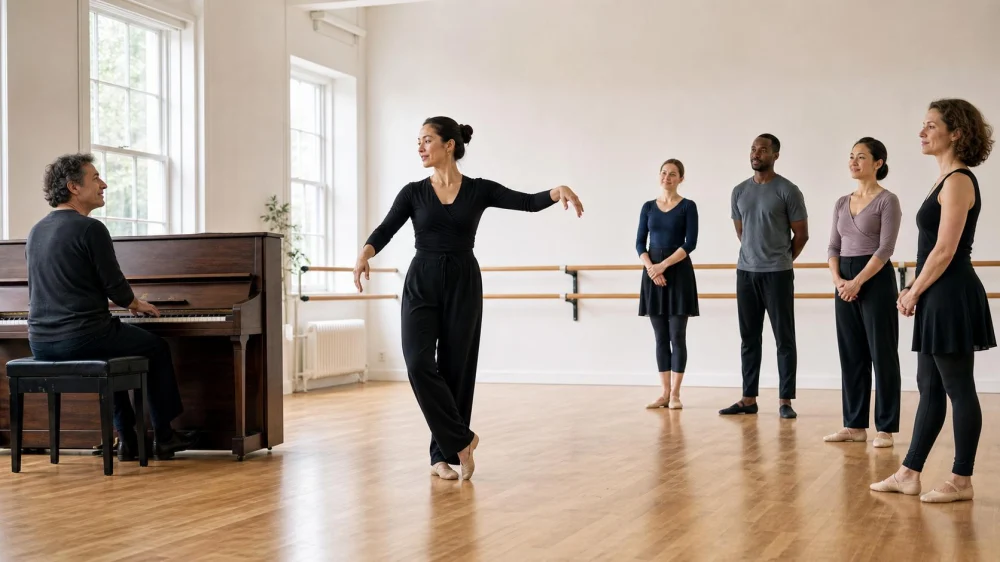
Dance Class With Live Music: Listen for Cues, Tempo, and Phrasing
On this page
Quick answer
In a dance class with live music, watch the teacher, listen for the accompanist's introduction, find the pulse, and begin on the demonstrated cue. Keep the assigned tempo and phrase rather than chasing every decorative note. Direct requests through the teacher unless the class invites questions, and thank the accompanist as a collaborating artist rather than treating the music as background.
Live music may vary slightly between groups. The goal is responsive musical dancing, not reproducing a recording exactly.
Virginia Ballet Company & School / virginia ballet company
5595 Guinea Rd, Fairfax, VA 22032, USA
Listen before you move
The accompanist may provide a short introduction that establishes tempo, meter, mood, and starting beat. Stay still enough to hear it, mark the first movement mentally, and use peripheral awareness of the teacher and group.
- Know whether the exercise begins immediately or after preparatory counts.
- Listen for strong and weak beats.
- Notice whether the phrase feels grouped in two, three, four, or another pattern.
- Do not talk over the introduction.
- If you miss the start, join at a safe phrase point instead of rushing through others.
Use tempo and phrasing
Tempo is the speed of the pulse; phrasing organizes movement and music into larger ideas. Keep steps aligned with the pulse while shaping energy across the phrase. An accent may invite a clear action, while a sustained sound may support length or suspension.
Do not assume every note equals one step. The teacher's counts and movement quality determine how the choreography fits the music.
The Little Gym of Pearland / little gym pearland
9607 Broadway St, Pearland, TX 77584, USA
Follow the teacher's communication
The teacher usually demonstrates the exercise and communicates tempo, meter, repeats, and ending to the accompanist. Listen to that exchange because it contains information for dancers. If the tempo or structure is unclear, ask the teacher at an appropriate pause.
- Watch the full demonstration.
- Hear the requested tempo and character.
- Confirm group direction and spacing.
- Listen to the introduction.
- Begin together and finish on the agreed cue.
Avoid calling instructions across the room directly to the musician unless that is the class norm.
Respect the accompanist and instrument
Keep bags, bottles, rosin, food, and personal items away from the instrument and musician's space. Do not touch the piano, percussion, cables, music stand, sheet music, or bench without permission. Leave a clear path and avoid standing where the accompanist cannot see the teacher.
Applause is not required after every exercise, but attentive silence, prompt readiness, and a sincere thank-you show professional respect.
Adapt when music changes
Live accompaniment may adjust for a different group, correction, energy, or exercise length. Maintain the teacher's movement sequence while listening for a new tempo or ending. If the phrase changes unexpectedly, prioritize spacing and safe control.
Use the experience to notice musical relationships: how the same combination feels with lighter articulation, stronger accents, different harmony, or a longer final cadence.
Important limitations
This is general class-etiquette and musicality guidance. Dance traditions, teachers, accompanists, meters, terminology, and studio practices vary. Follow the specific teacher and musician, and ask how communication works in that class.
Evidence notes
The listening sequence moves from introduction to pulse, phrase, movement cue, and ending. It treats the musician and dancers as coordinated participants, using the teacher as the main communication link to reduce conflicting instructions.
FAQ
What if I cannot find the first beat?
Watch the teacher, listen through the introduction, and ask for help at the next pause.
Should I count out loud?
Only if the teacher requests it; otherwise it may block others from hearing the music.
Can I ask for a slower tempo?
Ask the teacher, who can decide whether and how to request the change.
Why is the music different for each group?
The accompanist may adapt tempo, phrasing, or character to the teacher's request and group needs.
Can I place a bottle near the piano?
No. Keep liquids and belongings away from instruments and cables.
Next steps
At the next live-music class, focus on four moments: the teacher's demonstration, the musical introduction, the start of each phrase, and the final cue. Thank the accompanist before leaving.

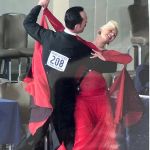 Stardust Ballroom Dance Studio5.0 (1 reviews)
 Midwest School of Ballet3.0 (3 reviews)
 The Shakti Rising4.0 (39 reviews)
 Socialsport Dance Club5.0 (12 reviews)
 The Cinnamon Tree Dance Shop Herndon4.0 (112 reviews)
 SDC Fine Arts Academy5.0 (1 reviews)
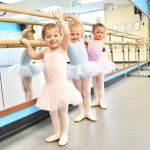 How to Develop a Growth Mindset for Learning Dance
 How I Prepared for a Dance Showcase as a Team — Planning & Execution Story
 How to Choose Dance Clothes That Are Functional and Stylish
 How to Teach Seniors in My Studio — My Story
 How to Prepare for Your First Dance Performance or Recital
 My Journey of Learning House Dance After Years of Studio Work — What Shifted