
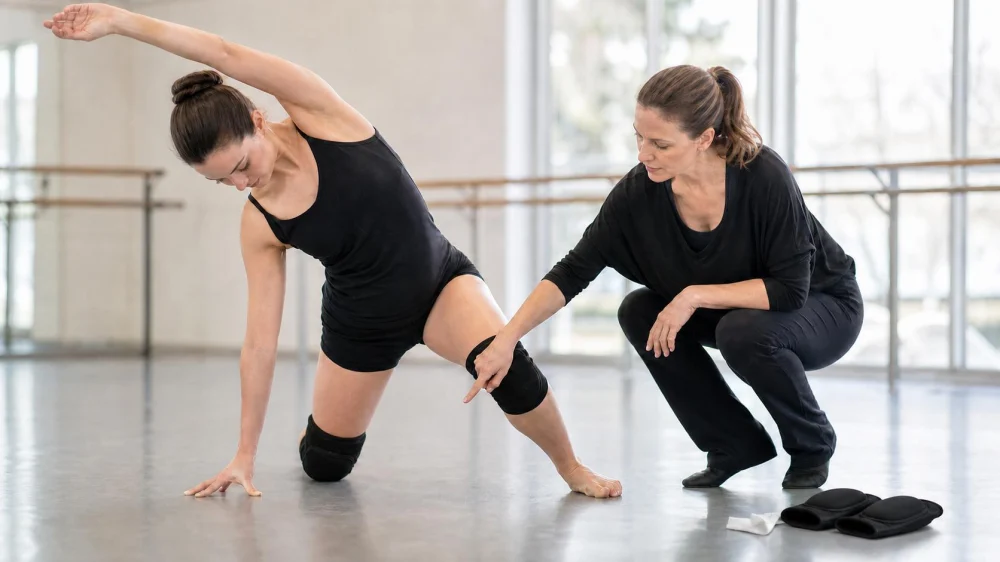
Dance Knee Pads: Fit, Grip, and Floorwork Checks
On this page
Quick answer
Dance knee pads should stay centered without cutting circulation, sliding, bunching, or changing floor traction unexpectedly. Match padding and outer fabric to the movement and studio floor, then test kneeling, transitions, slides, and standing at low speed. Pads reduce some surface pressure and friction, but they do not make unsafe impact technique or existing knee pain safe.
Next Step Dance / the next step dance studio
10850 Frisco St #200, Frisco, TX 75033, USA
When dancers use knee pads
Contemporary, commercial, heels, hip-hop, floorwork, and rehearsal choreography may include kneeling, crawling, sliding, or controlled drops. Knee pads can reduce direct contact and skin friction during planned movement.
Some styles, costumes, auditions, or stages do not allow visible pads. Ask the instructor or choreographer early and never introduce unfamiliar gear on performance day.
Dee Dots Dance Academy / dee dots
Woolwich TownshipGloucester CountyNew Jersey
360 Garwin Rd, Woolwich Township, NJ 08085, USA
Check fit
Measure according to the manufacturer's chart, usually around the knee or leg at a specified point. Sizes are not universal. Put pads on clean, dry skin or over the intended tights or pants.
- The padded centre aligns with the kneecap.
- Edges do not roll or create a hard ridge.
- The pad stays in place through bending and straightening.
- There is no numbness, tingling, color change, or throbbing.
- Straps and closures do not catch costumes or partners.
Choose padding and coverage
Thin low-profile pads preserve lines and may suit light floor contact. Thicker foam spreads pressure but can limit deep flexion or create a bulky landing surface. Gel, foam, and layered textile designs feel different as they warm and compress.
More padding is not automatically safer. A very thick pad can alter joint position, balance, and the transition from knee to foot.
Match the floor and style
Outer fabric affects grip. A smooth cover may slide easily on marley but move too quickly on another surface; a grippy cover may stop suddenly and twist clothing or the leg. Dust and sweat change traction.
Ask the studio whether the product is permitted. Do not add powder, rosin, water, tape, or sprays to modify the pad or floor without approval.
Test before full choreography
- Walk, bend, and straighten the knee.
- Kneel slowly with body weight partly supported by hands.
- Shift weight forward, back, and side to side.
- Practice the entry and exit without momentum.
- Test a short slide only when the instructor approves.
- Repeat in the actual costume layer.
- Check position, skin, and floor after each test.
Increase speed only after alignment, spacing, and traction are predictable.
Wear and adjust safely
Warm up before demanding floorwork. Stop if a pad shifts; move to clear space and reset it rather than adjusting during choreography. Keep pads matched left and right when the design differs.
For partner work, tell the partner that pads change grip, leg shape, and floor movement. Avoid hard uncontrolled drops. Safe floorwork uses coordinated technique through the whole body.
Clean and replace
Sweat and floor debris accumulate in fabric and foam. Follow the care label, wash after use as appropriate, and air-dry completely before packing. Do not share pads unless they can be properly cleaned between users.
- Replace compressed or uneven padding.
- Retire torn covers, exposed foam, loose straps, and broken closures.
- Check for odors, mildew, and skin irritation.
- Store dry and uncrushed in a ventilated bag.
Do not use pads to hide pain
Knee pads address contact with the floor, not every source of knee pain. Stop for sharp pain, swelling, locking, giving way, numbness, reduced movement, or symptoms that change technique. Seek evaluation from a qualified healthcare professional.
After a significant impact, inability to bear weight, visible deformity, or severe swelling requires prompt medical care. Do not take pain medicine only to continue rehearsing without medical advice.
Important limitations
This article is general dance-equipment and safety information, not injury prevention guarantee, medical advice, or choreography instruction. Bodies, floors, pads, styles, and techniques vary. Follow the instructor, venue, manufacturer, and clinician when applicable.
Sources and evidence notes
- Knee pad manufacturers: model-specific sizing, materials, permitted use, cleaning, and replacement.
- Dance medicine organizations: training-load, technique, and injury-response education for dancers.
- American Academy of Orthopaedic Surgeons: general warning signs for knee injury and when evaluation is needed.
- The studio and choreographer: controlling floor, costume, rehearsal, and performance requirements.
Frequently asked questions
Should knee pads feel tight?
They should stay secure without numbness, tingling, color change, deep marks, or restricted movement. Use the maker's sizing chart.
Can volleyball knee pads work for dance?
They may be too bulky or have different traction. Test only with instructor approval and match the product to dance movement.
Can I wear pads under tights?
Sometimes, but the layers change fit and friction. Test the complete costume well before performance.
Do pads make knee drops safe?
No. They cushion some contact but cannot correct uncontrolled force or alignment. Learn the choreography progressively with a qualified teacher.
Conclusion
Useful dance knee pads fit securely, match the floor, preserve movement, and remain clean and intact. Test every transition slowly before full choreography and stop when the pad shifts or the knee hurts. Treat padding as one equipment choice within sound technique—not permission to increase impact.


 Custom Fitness4.0 (15 reviews)
 The Little Gym of Bellevue-Redmond4.0 (68 reviews)
 The Professional Dance Company5.0 (6 reviews)
 Dance Studio B5.0 (8 reviews)
 Bailando Brillando4.0 (16 reviews)
 The Well Studio4.0 (71 reviews)
 How I Learned to Use AI-Generated Backdrops in My Dance Performance — My Story
 How I Learned to Use Time-Travel Themes in My Choreography — My Personal Story
 How to Create a Dance Routine for a Wedding Party – A Step-by-Step Guide
 How to Care for Your Feet as a Dancer: Prevention and Recovery
 My Journey from Beginner to Competitive Dancer in One Year
 My Experience With Dance Camps as a Teen — How It Shaped Me