
Dance Partner Rotation: Use Names, Boundaries, and Clear Reset Cues
On this page
Quick answer
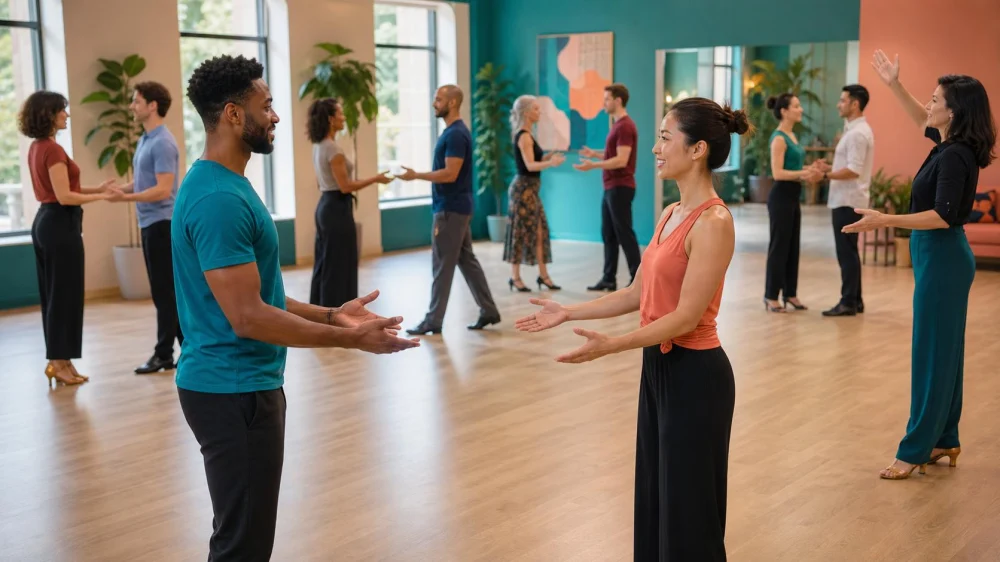
In a rotating partner dance class, introduce yourself, confirm the exercise and roles, use only the connection taught, agree on contact and speed, and follow the teacher’s stop and rotation cue. Thank the partner, release fully, move in the announced direction, and wait until the new pair has space before restarting. Boundaries and opt-outs apply at every rotation.
Rotation is a learning format, not consent to every hold, role, speed, or social interaction. The studio’s code of conduct and the teacher’s instructions control the drill.

Touch of Class Dance / touch of class dance
DowningtownChester CountyPennsylvania
150 E Pennsylvania Ave, Downingtown, PA 19335, USA
Before the first rotation
Listen for the pattern: who moves, which direction, whether roles switch, how many repetitions occur, and what signal stops the music. Locate fixed objects, bags, walls, mirrors, other lines, and the edge of the floor. Remove jewelry or loose items as required and keep hands clean and dry.
Tell the teacher privately about access needs, injury restrictions, contact limits, preferred role, height concerns, religious considerations, sensory needs, or a need to observe. Ask what opt-out or fixed-partner arrangement is available. A clear plan before the music prevents a student from having to explain personal details to every partner.
Arlington Ballroom LLC / arlington ballroom
ArlingtonArlington CountyVirginia
5130 Wilson Blvd, Arlington, VA 22205, USA
Make a clear connection
- Offer your name and ask the partner’s name without delaying the line.
- Confirm the assigned roles and exact exercise.
- Ask or signal readiness before making contact.
- Use the hand, frame, hold, and pressure level the teacher demonstrated.
- Begin below performance speed and adjust only by mutual comfort and teacher direction.
- Use the agreed stop word, hand release, or raised-hand signal immediately when needed.
Do not add dips, lifts, drops, spins, close holds, styling, or extra patterns that were not assigned. Skill level does not give one dancer permission to pull, grip, correct another body, or override a stop.
Rotate without confusion
At the cue, finish or safely stop the current movement, release hands and frame completely, thank the partner, and move in the designated direction. Do not cross the center, reverse the line, or chase a preferred partner unless the teacher directs it. New pairs should establish spacing before taking hold.
If an odd number leaves someone unpaired, follow the class system: join a trio, wait at a marked position, work with an assistant, or rotate in on the next round. Do not assume the person should lead, follow, or sit out. If the rotation stalls, stop moving and look to the teacher rather than sending conflicting directions down the line.
Handle boundaries and opt-outs
A dancer may decline a partner, hold, role, or repetition without public debate. Respond with “okay,” release, create space, and alert the teacher if the rotation needs re-routing. Do not demand a reason, tease, retaliate, or try again after a boundary was stated.
Report unsafe grip, repeated pressure, sexualized contact, discriminatory behavior, intoxication, or ignored stop cues according to studio policy. Teachers should address the flow without requiring the reporting dancer to negotiate alone. In an immediate safety concern, leave the floor and seek staff or emergency help.
Rotation checklist
- Direction, roles, repetitions, and stop cue heard
- Floor path and other lines checked
- Name and readiness exchanged
- Only the taught connection used
- Speed and pressure kept mutually workable
- Release completed before moving
- Opt-outs accepted without interrogation
- Unsafe conduct reported through studio process
Limitations
Partner customs differ across ballroom, social, folk, contemporary, contact improvisation, children’s, and adaptive classes. Some styles use different language for roles and connection. This guide does not teach physical partnering or replace the studio’s safeguarding, accessibility, and emergency procedures.
FAQ
Do I have to rotate?
Ask the teacher or studio. Some classes offer fixed partners, observation, or another accommodation; policies vary.
May I choose only one role?
Tell the teacher before the drill. Role design and class learning goals vary, and accommodations should be planned respectfully.
What if I forget a partner’s name?
Ask again briefly. Using the right name is better than avoiding communication.
Can I teach my partner during the rotation?
Follow the teacher’s format. Share a cue only if invited; do not physically adjust another dancer.
What if someone ignores my stop?
Release, leave the interaction, and tell the teacher or studio staff. Seek immediate help if you are unsafe.
Evidence notes
The studio’s published conduct policy, teacher demonstration, safeguarding process, and accessibility plan are the primary sources for a rotating class. Observable checks include complete release at the cue, predictable line movement, taught connection, and immediate respect for a stop or opt-out.
Conclusion
Good rotation keeps learning moving without making people feel interchangeable. Use names, confirm the drill, keep connection and speed within the instruction, release before moving, and treat every boundary as complete information.



 Oklahoma Dance Center I Home of Oklahoma Youth Ballet5.0 (3 reviews)
 Bollycurves | Bollywood Dance + Fitness + Yoga4.0 (237 reviews)
 Black Cat Belly Dance5.0 (3 reviews)
 The Gallery Dance Collective3.0 (2 reviews)
 DPAC Texas5.0 (24 reviews)
 Charlotte Dance Alliance4.0 (25 reviews)
 What is Salsa Rueda de Casino? The Cuban Group Dance
 How I Learned to Use Motion Capture for Audience Interaction — My Story
 The Best Mindset for Learning and Retaining Dance Choreography
 What is Line Dancing? Beyond the Electric Slide
 My Experience With Dance and Mindset Coaching — My Personal Growth
 How to Give a Performance Even If You're Not a Professional: Tips for Beginners