
Dance Prop Safety: Inspect Space, Handoffs, and Storage
On this page
Quick answer
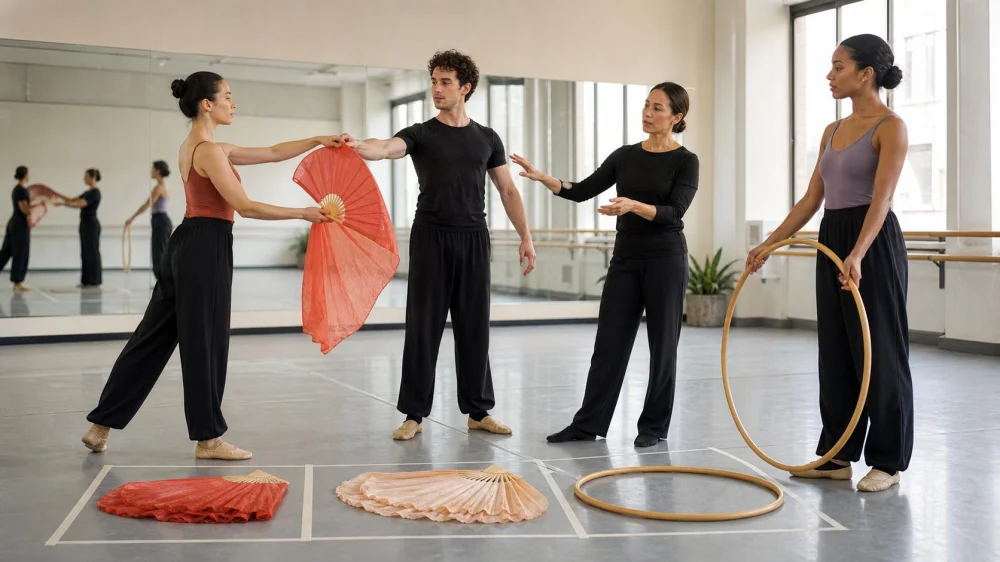
Use dance props only after the teacher, choreographer, and venue approve them. Inspect every handle, edge, joint, weight, fabric, fastener, and floor-contact point before rehearsal. Map the prop’s full swing, lift, roll, and drop zone, rehearse handoffs at low speed with clear cues, and designate secure preset and storage locations. Stop when a prop changes shape, grip, balance, or sound.
Never introduce fire, glass, weapons, liquids, powders, confetti, or thrown objects without explicit venue approval and professional controls.

Approve the prop first
- Exact material, dimensions, weight, and finish
- Who carries, lifts, rolls, throws, or receives it
- Whether it contacts the floor, costume, scenery, or audience
- Venue restrictions and fire, cleaning, and accessibility rules
- Transport, backstage, and storage requirements
- Duplicate or backup prop consistency
- Who has authority to remove it from use
A household object can behave differently under repeated dance movement. Decorative replicas should still be treated as performance equipment.

Petroleum Club of Shreveport / petroleum club shreveport
ShreveportCaddo ParishLouisiana
416 Travis St # 1500, Shreveport, LA 71101, USA
Inspect before rehearsal
- Compare the prop with the approved version.
- Check for cracks, splinters, sharp edges, loose hardware, and exposed wire.
- Test handles, straps, hinges, caps, and closures gently.
- Look for wet, oily, dusty, sticky, or shedding surfaces.
- Confirm weight and balance feel unchanged.
- Check soft goods for tears and entanglement risk.
- Label and quarantine damage according to studio procedure.
Do not repair a prop with last-minute tape, glue, staples, or wire unless the responsible production person approves the method.
Map the movement space
Walk the choreography without music and mark the prop’s widest reach, not only the dancer’s body. Include overhead clearance, floor travel, momentum, rebound, and the possibility of a missed catch. Keep mirrors, lights, sprinklers, curtains, cameras, cables, exits, and other dancers outside the buffer.
Test on the actual floor when permitted. Wheels, rubber tips, metal feet, fabric, and paint can grip, slide, scratch, or leave residue differently on each surface.
Practice handoffs
Name the giver and receiver, choose an agreed grip point, make eye contact when choreography allows, and use a spoken or musical cue. The giver releases only after the receiver has secure control. Start stationary, then add travel, tempo, costume, and lighting gradually.
Create a safe response for a missed handoff: let the prop fall in a designated direction, stop movement, or clear the area according to rehearsal instruction. Do not dive into another dancer’s path to save it.
Performance-day control
- Assign one person to inspect and preset each prop.
- Use taped outlines or labeled racks in approved backstage areas.
- Keep aisles, exits, quick-change zones, and accessible routes clear.
- Confirm stage crew and dancers use the same cue sequence.
- Prevent audience access before and after the show.
- Remove damaged props rather than improvising.
Run a spacing check after scenery, lighting, microphones, or cameras move.
Reset and storage
Count props after every rehearsal and performance. Clean by the material’s approved method, dry fully, and store so weight is supported and pieces cannot roll, fall, warp, or snag costumes. Separate wet or dirty props from dance shoes and clothing.
Record repairs, damage, and substitutions. A backup should be rehearsed and inspected, not simply assumed to match.
Frequently asked questions
Can we use a real glass or ceramic item?
A safer stage substitute is generally preferable. Follow venue and production safety approval.
Should props be marked with names?
Clear identification can prevent mix-ups, but labels must not change grip or create sharp edges.
Can a prop be thrown?
Only with choreographer and venue approval, trained participants, controlled space, and a rehearsed failure plan.
Who checks a prop before the show?
Assign a specific responsible person and document the procedure.
What if the prop feels different onstage?
Stop or use the agreed backup plan. Do not force choreography with altered equipment.
Sources and evidence notes
This guide applies performance-equipment inspection, dropped-object, collision, handoff, housekeeping, and venue-control principles. Exact requirements depend on the prop, choreography, participants, studio, venue, and production risk assessment.
Follow the teacher, stage manager, venue, manufacturer, and qualified production-safety guidance.
Conclusion and next steps
Approve one exact prop, inspect it before every use, and rehearse its full footprint and every transfer slowly. Give it a controlled preset and storage location, plus a failure cue everyone understands. If grip, weight, balance, surface, or structure changes, remove the prop and adapt the choreography instead of hoping it lasts one more run.




 North Myrtle Beach School of Performing Arts4.0 (7 reviews)
 Wave Dancer Charters4.0 (352 reviews)
 Progressions Dance School4.0 (24 reviews)
 Reach Dance Studio4.0 (46 reviews)
 Baltimore Dance Center Inc4.0 (10 reviews)
 passMORE DANCE4.0 (48 reviews)
 How to Find a Dance Mentor or Community Online
 How I Learned to Teach Beginner Adult Ballet — My Story of Gentleness
 How to Break In New Dance Shoes So They're Comfortable
 What is Vogue Fem? The Feminine Side of Ballroom Culture
 How I Learned to Teach Online Dance Classes for Seniors — My Story
 My Story of Performing in a Virtual Reality Arena With Thousands of Avatars — My Story