
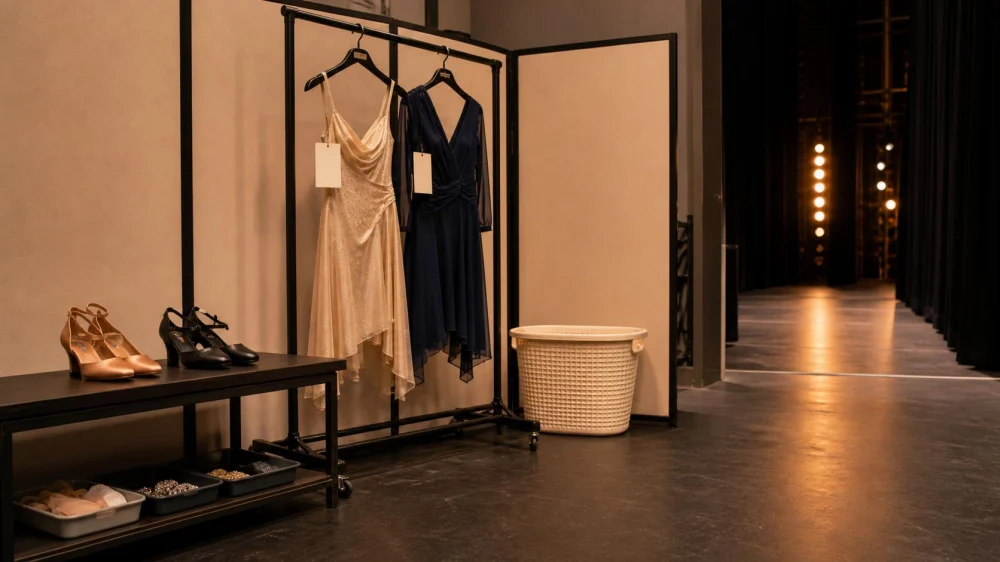
Dance Quick Change Plan: Costume Order, Privacy, and Timing
On this page
Quick answer
Plan a dance quick change by timing the full route from exit to re-entry, reducing the number of costume steps, arranging every item in dressing order, and assigning trained helpers with clear consent. Use a private, well-lit changing area with stable flooring and no blocked exits. Rehearse the actual costume, shoes, hair, props, and route at performance speed, then create a simple fallback if the change cannot be completed safely.
A successful quick change protects the dancer and the production. Missing an entrance is preferable to running through hazards, forcing a fastener, or entering with unsafe shoes or costume pieces.

Class Act Performing Arts / class act performing arts
EdgewaterAnne Arundel CountyMaryland
161 Mitchells Chance Rd, Edgewater, MD 21037, USA
Map the complete change
- Time the stage exit, travel, change, final check, and return.
- Note stairs, curtains, cables, props, low light, and crossing traffic.
- Choose a station close enough without blocking backstage work.
- Confirm which side of stage the dancer exits and re-enters.
- Assign who gives the leave-now or hold cue.
Use the shortest approved route, not a shortcut through restricted or active technical areas.

Petroleum Club of Shreveport / petroleum club shreveport
ShreveportCaddo ParishLouisiana
416 Travis St # 1500, Shreveport, LA 71101, USA
Prepare the costume in order
Place the first item to put on at the top or front. Open permitted zippers and fasteners, loosen laces, pair shoes, and organize accessories in stable shallow trays. Keep jewellery, pins, and small pieces only if approved and necessary.
- Remove outer pieces into a basket or clearly defined zone.
- Put on the base and main costume layers.
- Secure fasteners and check closures.
- Change shoes on a stable seated or supported setup.
- Add approved hair, accessory, or prop items.
- Perform a final front, back, hem, and shoe check.
Protect privacy and consent
Use screens, doors, robes, base layers, and access control appropriate to the dancer, venue, and costume. Confirm who may assist and exactly which tasks they will perform. A dancer can decline unwanted touch and should have a way to stop the change.
For minors, follow studio, venue, guardian, and safeguarding rules. Do not record or photograph quick-change areas, and keep unrelated people out.
Rehearse under real timing
Practice after dancing part of the preceding number so breathing, perspiration, and fatigue are realistic. Use performance lighting and the real backstage route when permitted. Time several attempts and identify the slowest step rather than relying on the best attempt.
Modify the costume through the designer or authorized wardrobe lead. Improvised cuts, magnets, snaps, or hook-and-loop changes can affect appearance, security, skin, choreography, and costume ownership.
Create a safe backup plan
Decide in advance which accessory can be omitted, whether an understudy cue applies, and who tells stage management that the dancer is not ready. Keep approved repair supplies and spare essentials at the station, but do not attempt complex repairs during the change.
Stop for a broken shoe, open closure, sharp fastener, breathing restriction, tangled costume, or blocked route. Use the agreed backup rather than rushing onstage.
Important limitations
This is general U.S. performance-planning information. Venue, production, safeguarding, labour, costume, fire, accessibility, and backstage rules vary. Follow the director, stage manager, wardrobe lead, studio, venue, and guardian requirements.
Evidence notes
The plan treats the change as a timed sequence with human, clothing, route, and privacy constraints. Ordering items, rehearsing realistic conditions, assigning helpers, and defining a stop rule reduce last-second improvisation.
FAQ
How fast should a quick change be?
Fast enough for the production only when every step can be completed safely and consistently.
How many helpers are needed?
Use the fewest trained helpers that the costume and privacy plan require.
Can fasteners be modified?
Only with approval from the costume owner, designer, or wardrobe lead.
Should dancers change shoes standing?
A stable seated or supported setup is usually safer when space and choreography allow.
What if the change is not complete?
Use the planned hold, omission, or missed-entrance procedure and notify stage management.
Next steps
Draw the route, list every clothing step, assign consenting helpers, build the private station, rehearse the actual sequence several times, and approve a clear backup plan with stage management.



 Stardust Ballroom Dance Studio5.0 (1 reviews)
 Midwest School of Ballet3.0 (3 reviews)
 The Shakti Rising4.0 (39 reviews)
 Socialsport Dance Club5.0 (12 reviews)
 The Cinnamon Tree Dance Shop Herndon4.0 (112 reviews)
 SDC Fine Arts Academy5.0 (1 reviews)
 How to Develop a Growth Mindset for Learning Dance
 How I Prepared for a Dance Showcase as a Team — Planning & Execution Story
 How to Choose Dance Clothes That Are Functional and Stylish
 How to Teach Seniors in My Studio — My Story
 How to Prepare for Your First Dance Performance or Recital
 My Journey of Learning House Dance After Years of Studio Work — What Shifted