
Dance Rehearsal Video: Consent, Framing, and File Control
On this page
Quick answer
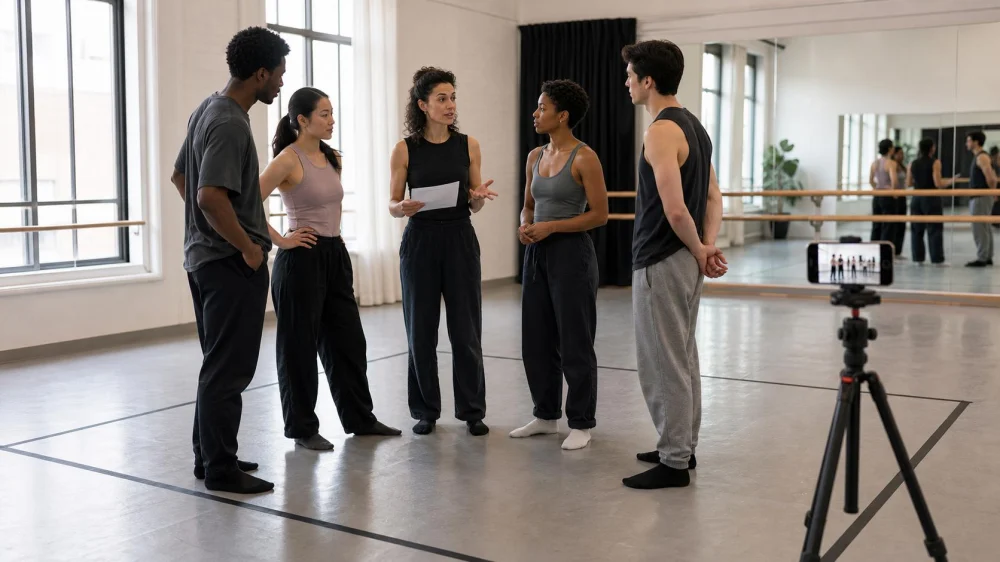
Before recording dance rehearsal, get the studio or production’s permission and informed agreement from everyone who may appear. State whether the video is for personal review, teacher feedback, casting, archive, promotion, or public posting. Frame only the approved dancers and space, keep the camera and tripod out of travel paths, store files securely, limit sharing, and delete them according to the agreed schedule.
Permission to record is not automatically permission to post, tag, edit, use for advertising, or train an AI system.
Expressions Dance Co / expression dance studio
AnnapolisAnne Arundel CountyMaryland
Arundel Plaza Shopping Center, 108 Old Solomons Island Rd, Annapolis, MD 21401, USA
Get permission first
- Teacher, choreographer, studio, and venue approval
- Consent from dancers and other identifiable people
- Parent or guardian process for minors
- Union, contract, competition, audition, or music restrictions
- Rules for observers, assistants, accompanists, and backstage areas
- How someone can opt out without disrupting class
Ask before the camera appears, not after recording. A posted studio policy can support the process but may not answer every use.
Galactic Dance Studio / quinceanera choreography near me
8501 Long Point Rd, Houston, TX 77055, USA
Define the purpose
Write one sentence describing the recording: for example, “full-group spacing review available to cast members for seven days.” Define who records, who receives access, whether downloads are allowed, and what happens after the purpose ends.
New uses need new permission. A private technique clip should not quietly become a social-media reel, promotional advertisement, portfolio, or public livestream.
Set up the camera safely
- Choose a fixed location outside entrances, exits, wings, and dance paths.
- Use a stable tripod with legs visible and guarded where necessary.
- Keep charging cables off the floor or secured by venue-approved methods.
- Frame the rehearsal area without mirrors revealing unapproved people.
- Check that changing, first-aid, office, and private areas are excluded.
- Use a brief test clip to verify angle and exposure.
- Assign one person to stop recording when the scene changes.
Do not hold a phone while moving through active choreography or place equipment where a dancer could collide with it.
Protect privacy
Minimize what the recording captures: avoid names on call sheets, medical or accommodation discussions, addresses, school logos, license plates, screens, and conversations unrelated to the dance. Pause recording during injury response, private corrections, costume changes, or personal discussion.
If someone opted out, use camera placement, separate run order, or another agreed method to keep them out. Blurring later is not a reason to ignore the original boundary.
Store and share files
- Use a studio-approved account or device where required.
- Restrict access to named participants.
- Disable public links and unnecessary downloads.
- Avoid personal group chats when an approved portal exists.
- Do not include sensitive names in filenames.
- Track versions so old choreography is not mistaken for current work.
- Delete local and cloud copies on the agreed date.
Report a lost device, wrong recipient, or accidental public link promptly through the studio’s process.
Review without harm
Use video to answer specific questions about timing, spacing, alignment, musicality, or transitions. Review at normal speed first and compare with the teacher’s goal. A single frame can distort movement and should not be used to shame appearance or technique.
Keep feedback inside the authorized group, focus on changeable actions, and do not repost another dancer’s mistake. Delete unnecessary clips after notes are complete.
Frequently asked questions
Can I record only myself in class?
Other people, music, mirrors, and choreography may still be captured. Ask first.
Does consent to a class photo cover video?
Not necessarily. Clarify the format, purpose, audience, and duration.
Can I post a rehearsal clip if everyone is tagged?
Tagging is not consent. Obtain specific permission and follow studio policy.
What if a minor appears in the background?
Stop and use the approved guardian and studio process; do not post the clip.
Should the studio keep every rehearsal video?
Retain only what the stated purpose and policy require, then delete securely.
Sources and evidence notes
This guide applies consent, data minimization, purpose limitation, access control, retention, and physical tripod-safety principles. Recording and privacy laws, contracts, child-safeguarding duties, and studio policies vary by jurisdiction and situation.
Use the studio or production policy and seek qualified legal advice for public, commercial, employment, audition, or minor-related recording questions.
Conclusion and next steps
Agree on the purpose, participants, audience, and deletion date before recording. Place the camera outside movement and private areas, capture only what review needs, and share through a restricted channel. Treat every new use as a new decision so rehearsal documentation supports learning without turning dancers into unplanned public content.

 North Myrtle Beach School of Performing Arts4.0 (7 reviews)
 Wave Dancer Charters4.0 (352 reviews)
 Progressions Dance School4.0 (24 reviews)
 Reach Dance Studio4.0 (46 reviews)
 Baltimore Dance Center Inc4.0 (10 reviews)
 passMORE DANCE4.0 (48 reviews)
 How to Find a Dance Mentor or Community Online
 How I Learned to Teach Beginner Adult Ballet — My Story of Gentleness
 How to Break In New Dance Shoes So They're Comfortable
 What is Vogue Fem? The Feminine Side of Ballroom Culture
 How I Learned to Teach Online Dance Classes for Seniors — My Story
 My Story of Performing in a Virtual Reality Arena With Thousands of Avatars — My Story