
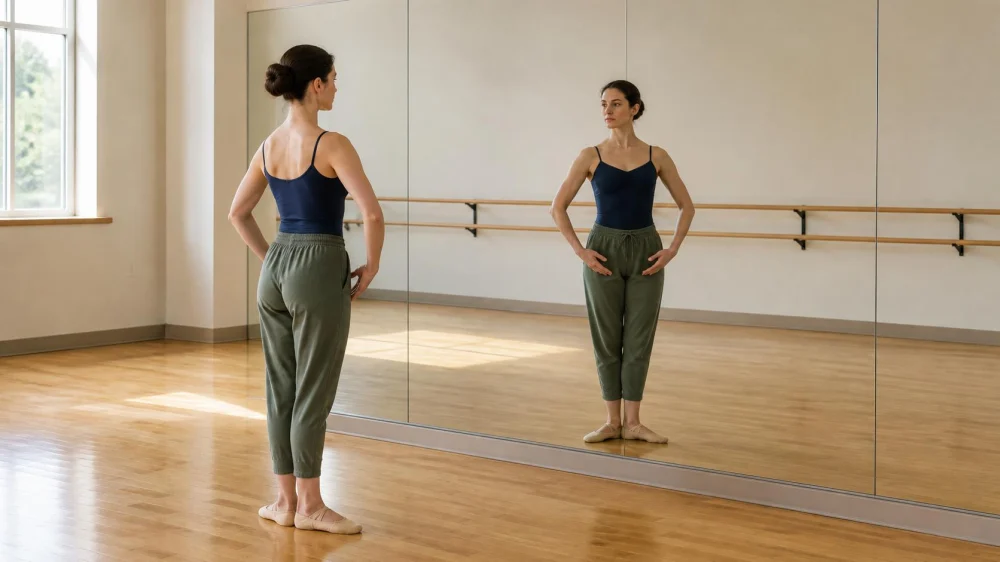
Dance Studio Mirrors: Check Alignment, Then Look Away
On this page
Quick answer
Use a dance studio mirror to answer one specific question, such as whether the pelvis is level or the arms match the intended line. Check briefly, make one adjustment, then repeat while looking away and noticing balance, pressure, breath, and timing. Alternating visual feedback with internal and spatial cues helps prevent the image from becoming your only guide.
Imagery In Motion Dance / imagery in motion
308 FM1830 STE 16C, Argyle, TX 76226, USA
Use the mirror for a defined purpose
A dance mirror provides immediate visual feedback about shape, direction, spacing, and group timing. It does not show every force acting through the body, and the viewing angle can make a position appear different from how it functions.
Before looking, choose one question:
- Are the knees tracking in the intended direction?
- Is the torso stacked or unintentionally shifted?
- Do the arms maintain the planned pathway?
- Is the working leg using the requested height and direction?
- Am I keeping safe distance from another dancer?
- Does the group arrive at the same count?
A specific question produces usable feedback. General staring often produces many observations but no clear change.
The Dance Connection / the dance connection
WaterfordCamden CountyNew Jersey
386 White Horse Pike, Atco, NJ 08004, USA
Build a quick alignment scan
- Set the base. Notice foot contact or seated support before changing the upper body.
- Check one joint relationship. Compare the requested line of ankles, knees, hips, ribs, shoulders, and head without forcing them into a rigid stack.
- Watch the transition. Alignment during movement can matter more than the final pose.
- Make one small adjustment. Change direction, range, or muscle effort only as instructed.
- Test function. Ask whether balance, breath, control, and movement quality improved.
Do not chase a visually dramatic line that requires twisting a joint, gripping the breath, or losing stable support. Technique should serve the movement and the dancer's current structure.
Practice the same skill without the image
After checking the mirror, turn to another wall or soften your gaze and repeat the movement. Use internal cues such as pressure through the foot, weight over the support, ease of breathing, and the path of the limbs. Use external cues such as a wall, floor line, musical accent, partner, or direction in the room.
Then return to the mirror once and compare. If the correction disappears, reduce the movement and practice the sensation again. This check–adjust–look-away cycle turns the mirror into feedback rather than continuous control.
Apply mirror strategies in class
- Stand where you can see the teacher without twisting the neck repeatedly.
- When learning a new sequence, prioritize direction and timing before evaluating small visual details.
- Use peripheral vision for spacing instead of locking onto your face or one body part.
- Change facings when the teacher asks so technique transfers beyond the front wall.
- For traveling work, look toward the movement path rather than back at the mirror.
- Ask which visual landmark matters if several corrections compete for attention.
Avoid common mirror errors
Turning the head to inspect a side view: use a planned pause or teacher feedback instead of changing alignment during a moving skill.
Correcting everything at once: select one cue and preserve the rest of the movement.
Comparing bodies: compare the action with the instruction, not your proportions with another dancer's.
Losing the room: keep awareness of traffic, equipment, and partners even when checking the image.
Depending on the front: practice without the mirror so turns, stage orientation, auditions, and performance do not remove your only reference.
Limitations and important notes
- A mirror is not a diagnostic tool for pain, injury, scoliosis, joint instability, or another health condition.
- Stop a movement that causes sharp, escalating, or unusual pain and seek appropriate professional guidance.
- Some dancers experience distress, distraction, or harmful appearance comparison around mirrors. Tell the instructor and discuss a different position or feedback method.
- Do not lean on, strike, or place loose equipment against studio mirrors.
- Lighting, seams, wall angle, and distance can affect what the image appears to show.
Frequently asked questions
Should beginners always face the mirror?
No. It can help with demonstrations and spacing, but beginners also need to develop balance, directional awareness, musical timing, and movement sensation without constant visual checking.
How long should I look at one correction?
Long enough to identify the target and test one adjustment, often just a few repetitions. Then look away and see whether the change remains.
Why does a movement feel different when I turn away?
The mirror was supplying orientation and immediate confirmation. Slow the movement, use a floor or room landmark, and rebuild the internal cue before adding speed.
Can I use a phone camera instead?
Only with studio permission and consent from everyone captured. Video offers delayed feedback from one angle and creates privacy and file-control responsibilities.
What if mirror practice increases body criticism?
Shift to task-based cues, another place in the room, or nonvisual feedback and speak with the teacher. Seek qualified support if distress is persistent or affects eating, training, or daily life.
Conclusion and next steps
At the next class, choose one movement and one visual question. Check the mirror, apply a single correction, then repeat away from it using pressure, balance, direction, and timing. Keep the mirror when it clarifies the task and reduce it when it distracts from learning.
Evidence note: These recommendations reflect broad motor-learning, dance-pedagogy, and studio-safety principles. Individual technique should be guided by the instructor and health concerns by an appropriately qualified professional.

 Boulder Body Wear4.0 (177 reviews)
 Bethesda Conservatory of Dance4.0 (41 reviews)
 Gocha Shorena Center of Ballroom Dance5.0 (49 reviews)
 Redding Jazzercise Center5.0 (10 reviews)
 Steps of Faith Dance Studio5.0 (31 reviews)
 Fred Astaire Dance Studios - Houston4.0 (36 reviews)
 10 Things Every Beginner Hip‑Hop Dancer Wishes They Knew
 The Best Dance Styles for Improving Self-Esteem and Body Image
 My Experience With Dance in Different US Cities — My Travel Story | Creative Edge Dance Studio
 How I Learned to Teach Aerial Hoop Dance — My Journey of Discovery
 The Science of How Learning Dance Benefits Your Brain
 What is 'Freestyle' Dancing and How to Get Started