
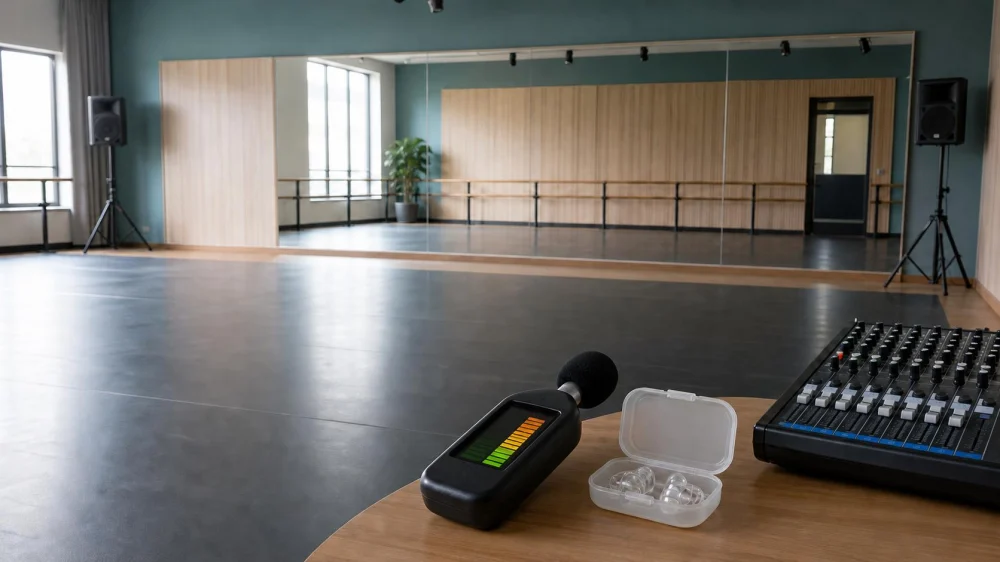
Dance Studio Sound Levels: Protect Hearing in Rehearsal
On this page
- Quick answer
- Sound level and time work together
- Recognize a studio sound problem
- Measure before guessing
- Lower sound at the source and in the room
- Choose hearing protection for movement and cues
- Keep counts and safety cues audible
- Respond to hearing symptoms
- Rehearsal hearing checklist
- Frequently asked questions
- Sources and evidence notes
- Conclusion and next steps
Quick answer
If dancers, teachers, musicians, or technicians must raise their voices at arm’s length, experience ringing or muffled hearing after class, or rehearse near loud speakers for long periods, treat sound exposure as a safety issue. Lower the system level, increase distance from speakers, improve speaker placement and room acoustics, schedule quiet breaks, and measure representative sessions.
Hearing protection can help when controls do not reduce exposure enough, but it must fit, stay secure during movement, and preserve essential counts and warnings. NIOSH recommends controlling noise at the source before relying on personal protective equipment.
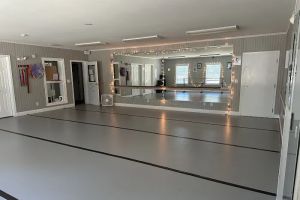
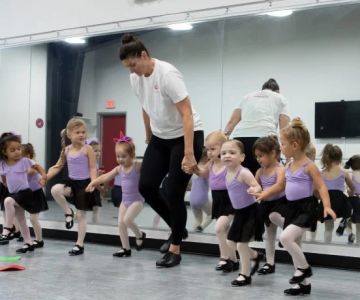
Dee Dots Dance Academy / dee dots
Woolwich TownshipGloucester CountyNew Jersey
360 Garwin Rd, Woolwich Township, NJ 08085, USA
Sound level and time work together
Hearing risk depends on both intensity and duration. A short music cue and a full-volume multi-hour rehearsal are not the same exposure. Repeated sessions, teaching several classes, performing, and working near monitors can add together across a day.
NIOSH uses 85 A-weighted decibels over an eight-hour workday as its recommended occupational exposure limit, with allowable time decreasing as level rises. That occupational framework is not a universal legal limit for every dancer, child, or studio, but it is a useful reason to measure and control repeated loud music rather than waiting for symptoms.
Born 2 Dance Studio - Vienna / born to dance vienna
262 Cedar Ln SE, Vienna, VA 22180, USA
Recognize a studio sound problem
- People must shout to communicate at arm’s length.
- Ears ring, buzz, or feel full after rehearsal.
- Speech or music sounds dull after leaving.
- Dancers repeatedly ask for louder counts.
- One side of the room feels much louder near a speaker.
- Teachers increase volume as fatigue builds.
- Emergency or stop cues are masked by the track.
Temporary symptoms are warnings, not evidence that the ears have safely “adapted.” Noise-induced hearing damage can accumulate and may be permanent.
Measure before guessing
Assess the actual class, rehearsal, and performance setup, including warm-up, full runs, speaker checks, and quiet periods. Record sound level, duration, location, distance from speakers, room configuration, and who is exposed. A qualified occupational hygienist or acoustical professional can evaluate complex or high-level environments.
A calibrated sound-level meter is preferred. The NIOSH Sound Level Meter app can provide useful screening on compatible devices, but a phone reading depends on the device, microphone, settings, and method. One brief measurement does not represent a fluctuating rehearsal.
Lower sound at the source and in the room
Start with the mixer or playback device. Use only the level needed for musical detail and group timing. Reposition speakers so dancers are not directly in front of high-output drivers, elevate or angle them appropriately, and distribute sound more evenly instead of overpowering one source.
Maintain equipment to avoid distortion and sudden peaks. Add suitable acoustic absorption to reduce reflections in hard rooms, manage subwoofer placement, and use smaller monitors for close instruction when appropriate. Schedule quiet breaks and rotate staff away from the loudest locations.
NIOSH notes that even a 3 dB reduction can materially reduce exposure. A quieter studio can also improve speech clarity and situational awareness.
Choose hearing protection for movement and cues
When sound cannot be reduced adequately, select protection based on measured exposure, movement, comfort, communication, and fit. NIOSH describes flat-attenuation or “musicians’” earplugs as reducing frequencies more evenly, which can preserve music fidelity better than some alternatives.
Avoid overprotection that masks stop calls, spacing instructions, or alarms. Fit testing is the best way to confirm actual attenuation. Reusable products need cleaning and inspection, and nothing should protrude or loosen during floorwork, turns, or partnering.
Noise-canceling consumer earbuds are not hearing protection unless specifically labeled and rated for that purpose.
Keep counts and safety cues audible
Set a standard stop signal that works even if the music fails or protection is worn. Combine a clear verbal cue with a visible gesture or lighting cue where practical. Confirm understanding before full runs, lifts, moving scenery, or low-light rehearsals.
Do not increase music simply because the instructor is speaking from the far side of the room. Use a lower track level, better speaker distribution, pauses for notes, or an appropriate voice-amplification system.
Respond to hearing symptoms
Move to a quiet area if ringing, muffled hearing, pain, dizziness, or sound sensitivity begins. Report it to the studio and document the session and speaker location. Avoid another loud exposure while seeking guidance.
Persistent or recurrent ringing, hearing change, ear pain, drainage, sudden hearing loss, or balance symptoms require evaluation by a healthcare professional or audiologist. Sudden hearing loss is urgent and should not wait for the next rehearsal.
Rehearsal hearing checklist
- Notice shouting, ringing, or muffled hearing.
- Measure representative sessions and locations.
- Record level, duration, and speaker distance.
- Lower playback level before adding earplugs.
- Improve placement and room absorption.
- Schedule quiet breaks and rotate exposure.
- Fit-test appropriate hearing protection.
- Preserve counts, stop calls, and alarms.
- Refer persistent symptoms for clinical evaluation.
Frequently asked questions
Is 85 dBA a safe target for every class?
It is a NIOSH occupational reference over eight hours, not a universal guarantee. Duration, individual factors, and local requirements matter.
Can a phone app certify the studio?
No. It can screen and document patterns, but complex exposure needs calibrated measurement and qualified interpretation.
Are musician earplugs suitable for dance?
They may preserve musical detail, but protection must match measured exposure, fit securely, and keep safety cues audible.
Do noise-canceling earbuds protect hearing?
Not unless they are labeled and rated as hearing protection.
What if only one corner is loud?
Map the room and change speaker position, dancer spacing, or output distribution rather than averaging away the hotspot.
Should ringing after class be ignored if it fades?
No. It is a warning of excessive exposure and should trigger sound-control review.
Sources and evidence notes
NIOSH guidance on understanding noise exposure describes its 85 dBA occupational recommended exposure limit and practical warning signs. Its hearing-protection guide explains fit, flat attenuation, communication, and avoiding overprotection.
The NIOSH article Reducing the Risk of Hearing Disorders Among Musicians recommends monitoring level and duration, lowering rehearsal volume, taking quiet breaks, and using appropriate protection. Studio owners should also follow local occupational, school, and venue rules.
Conclusion and next steps
Use shouting, ringing, and muffled hearing as prompts to measure, not as normal parts of dance culture. Reduce sound at the system and room first, manage duration and distance, and fit suitable protection when needed. Keep counts and emergency cues clear, and refer persistent hearing symptoms promptly.
 Gold's Gym4.0 (599 reviews)
 Studio 4 School of Dance4.0 (3 reviews)
 Heath's Gym Dance Crew5.0 (2 reviews)
 Sonshine Academy4.0 (115 reviews)
 Dancin' On Broad5.0 (1 reviews)
 Dynamic Dance DFW4.0 (37 reviews)
 Why Are Dance Classes So Expensive? A Breakdown of Costs
 My Experience With Dance as a Couple Activity — A Story of Connection
 The Best Dance Styles for Kids to Build Discipline and Fun
 The Role of Breathwork in Dance Performance and Execution
 How to Layer Clothing for Cold Weather Dance Practice: Stay Warm and Move Freely
 How I Learned to Use Music Production for My Dance Choreography — My Story