
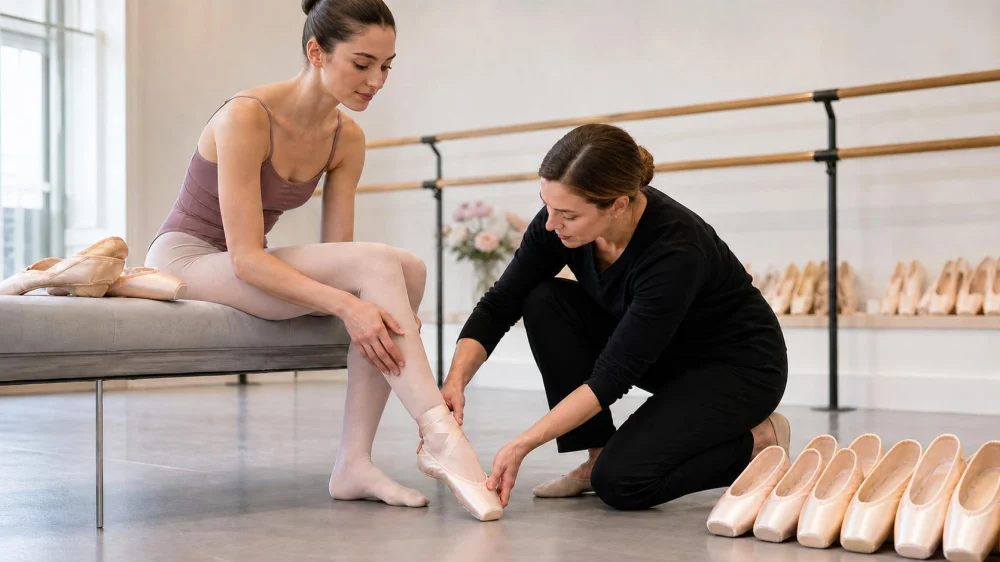
First Pointe Shoe Fitting: Bring Your Teacher’s Requirements
On this page
- Quick answer
- Readiness comes before shopping
- Prepare for the fitting appointment
- What the fitter and teacher should check
- Test only the movements you are cleared to do
- Choose padding after the shoe shape
- Get teacher approval before sewing
- Know when fit has changed
- First fitting checklist
- Frequently asked questions
- Sources and evidence notes
- Conclusion and next steps
Quick answer
Do not buy a first pair of pointe shoes until the ballet teacher has confirmed readiness and supplied any school requirements. Book an individual fitting with a trained pointe-shoe fitter, bring the tights and toe protection approved by the teacher, and allow enough time to compare several models. Fit should be secure and supportive without crushing toes, causing numbness, or forcing the foot out of alignment.
Before sewing ribbons or elastics, have the teacher review the selected pair when the school requires it. A beautiful line in a photograph does not prove that the dancer has the strength, control, range, technique, or correctly fitted shoe needed for pointe work.
Class Act Performing Arts / class act performing arts
EdgewaterAnne Arundel CountyMaryland
161 Mitchells Chance Rd, Edgewater, MD 21037, USA
Readiness comes before shopping
The International Association for Dance Medicine & Science emphasizes that chronological age alone does not determine pointe readiness. Strength, neuromuscular control, skill, alignment, training history, maturity, and the teacher’s assessment all matter. Flexibility without control is not enough.
A shoe fitting cannot create readiness. Do not use a store appointment, peer comparison, recital deadline, or a birthday as permission to begin pointe. A dancer with pain, recent injury, major growth change, or unresolved alignment concern may need a dance-medicine evaluation before progression.

Electric Cowboy Longview / electric cowboy longview photos
1016 McCann Rd, Longview, TX 75601, USA
Prepare for the fitting appointment
- Bring the teacher’s brand, model, color, padding, ribbon, and elastic rules.
- Wear clean convertible tights or the approved fitting layer.
- Bring only the toe pads or spacers the teacher has authorized.
- Trim nails comfortably without cutting them excessively short.
- Schedule enough time and avoid arriving immediately after a fatiguing class.
- Tell the fitter about pain, blisters, bunions, different-sized feet, prior injuries, and orthoses.
Do not purchase used pointe shoes for a first fitting. The box and shank may have molded to another foot or lost support even if the satin looks clean.
What the fitter and teacher should check
The fitter considers length, width, toe shape, box shape, vamp, platform, wing support, profile, heel, shank strength, and how the two feet differ. Toes should remain lengthened rather than curled or overlapped. The metatarsals should not be excessively squeezed, and the heel should not slide away during approved movement.
IADMS notes that a pointe shoe that is too narrow, short, or soft can squash toes and reduce support. A shoe that is too wide or long can allow sinking, friction, and instability. Do not buy extra growing room; pointe fit is not the same as everyday shoe fit.
Test only the movements you are cleared to do
Follow the fitter and teacher. A first fitting may include parallel standing, first position, plié, relevé at a stable barre, and observation of alignment. Do not attempt unsupported pointe, balances, turns, or jumps to “prove” the shoe.
Check both feet through the approved range. Look for centered weight over the platform, stable ankle alignment, secure heel, appropriate box contact, and no sharp pressure, numbness, or burning. Fatigue can change control, so the goal is fit assessment, not a mini class.
Choose padding after the shoe shape
Toe pads, spacers, lamb’s wool, tape, and gel products change internal volume. Start with the school’s allowed minimal setup and fit the shoe around that choice. Thick padding should not be used to rescue an oversized box or hide severe pressure.
Do not place padding over broken skin without appropriate wound care, and do not share reusable toe pads. Persistent numbness, bruising, skin breakdown, or focal pain requires the dancer to stop and tell the teacher, parent or guardian, and healthcare professional as appropriate.
Get teacher approval before sewing
Many studios want to inspect a first pair before ribbons and elastics are attached. Keep the receipt, box, packing, and shoes unmodified until approval. Stand and perform only the requested checks in front of the teacher.
Sewing method and placement affect support and school uniform standards. Follow the teacher and shoe instructions; do not copy an online placement that was designed for another foot or model.
Know when fit has changed
Feet and technique change, especially during growth. Refit after a major size or shape change, persistent new pressure, loss of heel security, altered alignment, or a change in padding. Each new model and size deserves a fresh assessment.
A dead shoe may feel soft, unstable, noisy, or unable to support the dancer as intended. Replacement timing varies with model, dancer, choreography, floor, moisture, and hours of use. The teacher should help decide when a pair leaves service.
First fitting checklist
- Receive teacher clearance for pointe training.
- Bring written studio shoe requirements.
- Book an individual trained fitting.
- Wear approved tights and padding.
- Compare several shapes and strengths.
- Check both feet without curled or numb toes.
- Test only teacher-approved movements at support.
- Keep shoes unsewn until required approval.
- Report pain, skin injury, and fit changes.
- Schedule a new fitting as the feet and training change.
Frequently asked questions
What age is right for pointe shoes?
Age alone is not enough. The teacher evaluates strength, control, technique, development, and training consistency.
Should pointe shoes hurt?
They feel firm and demanding, but sharp pain, numbness, burning, crushing, or skin injury is not a fit goal.
Can I buy room to grow?
No. Extra length or width can allow sinking and instability. Refit when the foot changes.
Should I buy the brand my friend wears?
No. Foot shape, strength, technique, and school requirements differ.
Can thick toe pads fix a loose shoe?
They can change volume but should not rescue the wrong shoe shape or size.
Why wait before sewing ribbons?
Some stores accept returns only if unmodified, and the teacher may need to approve the fit first.
Sources and evidence notes
The IADMS Guidelines for Initiating Pointe Training explains why readiness depends on strength, control, range, technique, and individual development rather than age alone. IADMS discussion of pointe shoe fit and the big-toe joint describes problems with overly narrow, short, or soft boxes.
The dancer’s teacher, qualified fitter, product instructions, and healthcare team determine the appropriate shoe and progression.
Conclusion and next steps
Get readiness approval before shopping, bring the teacher’s exact requirements, and use an individual trained fitting to compare shape and support. Test only cleared movements, keep the pair unmodified until teacher approval, and refit whenever pain, growth, wear, or alignment changes.
 Gold's Gym4.0 (599 reviews)
 Studio 4 School of Dance4.0 (3 reviews)
 Heath's Gym Dance Crew5.0 (2 reviews)
 Sonshine Academy4.0 (115 reviews)
 Dancin' On Broad5.0 (1 reviews)
 Dynamic Dance DFW4.0 (37 reviews)
 Why Are Dance Classes So Expensive? A Breakdown of Costs
 My Experience With Dance as a Couple Activity — A Story of Connection
 The Best Dance Styles for Kids to Build Discipline and Fun
 The Role of Breathwork in Dance Performance and Execution
 How to Layer Clothing for Cold Weather Dance Practice: Stay Warm and Move Freely
 How I Learned to Use Music Production for My Dance Choreography — My Story