
How to Prepare for a Dance Workshop With a Guest Teacher
On this page
- Quick answer
- Confirm the workshop details
- Set a realistic learning goal
- Prepare your body without pre-fatiguing it
- Pack for the style and venue
- Use the first minutes well
- Learn from an unfamiliar teaching style
- Handle recording, contact, and attribution
- Review the workshop afterward
- Safety and limitations
- Frequently asked questions
- Conclusion and workshop checklist
Quick answer
Before a guest-teacher dance workshop, confirm the style, level, schedule, floor, footwear, registration, recording policy, and accessibility. Arrive rested with appropriate clothing, water, layers, and a notebook. Set one learning goal, listen for the teacher's vocabulary, mark unfamiliar material before dancing full-out, ask concise questions at the right time, and follow consent and video rules. Review notes soon afterward instead of trying to master everything in one class.

Electric Cowboy Longview / electric cowboy longview photos
1016 McCann Rd, Longview, TX 75601, USA
Confirm the workshop details
A familiar style label can cover very different movement vocabulary and expectations. Use the host studio's official announcement and ask questions before the event.
- Exact date, local time, check-in window, and duration
- Style, stated level, age limits, and prerequisites
- Teacher biography and the class focus
- Studio address, parking, transit, entrance, and accessibility
- Floor type and required or prohibited footwear
- Whether observers, parents, or assistants may enter
- Refund, transfer, capacity, and waitlist policies
- Photography, video, and social-media rules
Do not assume “open level” means every combination will be appropriate for every body or training history. Ask the host what baseline skills, pace, and impact level to expect.
Class Act Performing Arts / class act performing arts
EdgewaterAnne Arundel CountyMaryland
161 Mitchells Chance Rd, Edgewater, MD 21037, USA
Set a realistic learning goal
A workshop is a sample of another artist's process, not an exam on instant perfection. Choose one or two goals that you can observe:
- Learn how the teacher organizes weight shifts
- Notice a new musicality or phrasing approach
- Practice picking up choreography without freezing after a mistake
- Experience a style before choosing a longer class
- Collect one useful correction or creative prompt
A narrow goal helps you decide where to stand, what to write down, and which question to ask. It also prevents comparison with dancers who have trained with the teacher before.
Prepare your body without pre-fatiguing it
Keep the preceding day and travel schedule appropriate to your current conditioning. Avoid adding an unusually hard workout, aggressive stretching session, or unfamiliar shoes just before the workshop.
On the day:
- Eat and hydrate in a way already familiar to you.
- Arrive early enough to change and settle without rushing.
- Use the teacher's warm-up as the main class preparation.
- If permitted, begin with gentle personal movement rather than high kicks, deep stretches, or full-out jumps.
- Tell the host privately about a relevant injury, disability, pregnancy, or medical restriction when a modification or emergency plan is needed.
The International Association for Dance Medicine & Science publishes public dance-health resource papers, including material on warm-up, fitness, motor learning, mirrors, and training with injury. General reading cannot replace personalized clinical or teaching advice.
Pack for the style and venue
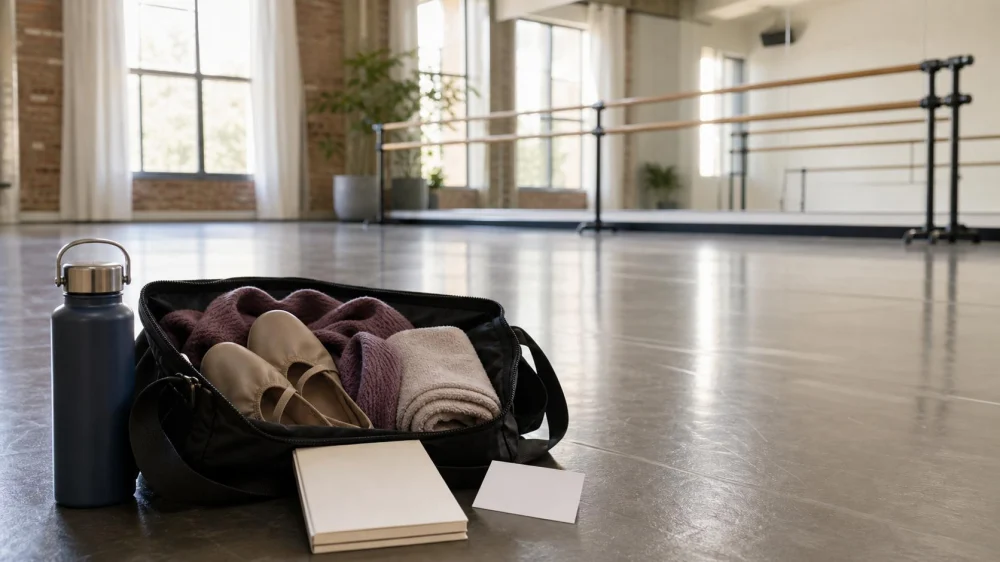
Bring only items that support the class and can be stored away from the floor:
- Clothing that permits movement and lets the teacher see relevant alignment
- Required dance shoes plus a clean backup if practical
- Warm layers for waiting and cooling down
- A secure water bottle
- Small towel and any permitted personal supports
- Notebook and pen for use after class
- Registration proof and emergency contact information
- Simple hair and jewelry arrangements that meet studio rules
Do not wear outdoor shoes on a dance floor unless the host expressly allows them. Test new footwear before the workshop rather than discovering friction, fit, or traction problems during class.
Use the first minutes well
- Check in and confirm the correct room.
- Locate exits, restrooms, water, and the area for belongings.
- Inspect the floor and report moisture, debris, or damage.
- Choose a place where you can see without crowding the front.
- Introduce yourself briefly only if the teacher or host invites it.
- Silence devices and store them according to the recording policy.
If you arrive late, wait at the edge for acknowledgment. Entering through a moving combination can disrupt spacing and safety.
Learn from an unfamiliar teaching style
Guest teachers may count, demonstrate, name steps, correct, and structure groups differently. Listen for repeated cue words and watch a full demonstration before copying fragments.
- Mark first: Use smaller, slower movement while learning direction and order.
- Identify anchors: Remember starting shape, major directional change, musical accent, and finish.
- Recover forward: If you miss a step, rejoin at the next anchor rather than stopping in a travel lane.
- Rotate lines: Follow the teacher's system so everyone can see.
- Ask one precise question: Name the location in the phrase and the choice you do not understand.
- Accept a modification: Smaller range, lower impact, slower speed, or an alternate direction can preserve learning.
Do not turn a correction given to another dancer into an assumption about their body or skill. Apply it only when the teacher makes it general.
Handle recording, contact, and attribution
Workshop choreography, music, and teaching materials may have recording and use restrictions. Ask before filming, photographing, livestreaming, or posting. Permission to record for personal review does not automatically allow publication or teaching the material elsewhere.
When partner work or hands-on correction appears:
- Listen for the contact points and roles.
- Ask before touching a partner.
- Use the stated opt-out or request a no-contact cue.
- Do not add lifts, grips, or weight sharing beyond the instruction.
- Stop when consent, footing, timing, or understanding is lost.
If posting is allowed, credit the teacher and host accurately and respect dancers who do not consent to appearing in the frame.
Review the workshop afterward
Within a few hours, write down:
- The main movement or creative idea
- One cue that improved your dancing
- A section that remains unclear
- A modification that worked
- What you want to explore in regular class
Follow the teacher's policy before reconstructing choreography from memory or video. If you share a reflection, describe your own learning rather than publishing a step-by-step reproduction without permission.
Notice how your body responds later that day and the next. Ordinary fatigue and serious symptoms are not the same; seek appropriate help for injury concerns.
Safety and limitations
This is general educational guidance, not personalized dance training or medical care. The guest teacher and host studio control class rules, choreography, floor use, and recording. A single workshop is not sufficient preparation for pointe work, lifts, acrobatics, extreme range, or other advanced skills.
Stop for sharp pain, a head impact, faintness, severe dizziness, chest symptoms, new numbness, joint instability, or inability to bear weight. Seek urgent medical help for emergency symptoms. Tell the teacher when you need to exit; do not disappear during an injury or safeguarding concern.
A respectful workshop allows questions, reasonable modifications, and boundaries without humiliation. Report harassment, coercion, unsafe contact, or retaliation through the host's safeguarding process.
Frequently asked questions
Where should I stand in a guest workshop?
Choose a place where you can see while respecting line rotation and spacing. The front is not the only place to learn.
Should I take notes during class?
Only when the teacher permits it and movement has paused. Taking notes should not block a lane or make you miss safety instructions.
Can I attend a level above mine?
Ask the host before registering. If accepted, be ready to mark, modify, and observe rather than forcing advanced material.
Is it rude to skip a combination?
No when you cannot perform it safely or do not understand it. Move to an approved observation area and tell the teacher when appropriate.
Can I ask the teacher for career advice afterward?
If time and event policy allow, ask one concise question. Do not expect a long private consultation while another class is checking in.
Conclusion and workshop checklist
Confirm the level and logistics, choose one goal, arrive rested and equipped, learn the teacher's cue system, mark before going full-out, and respect contact and recording rules. Review one or two durable lessons afterward. A successful workshop is not the one where you copy everything instantly; it is the one that adds a clear, safe idea to your ongoing dance practice.

 Grace & Pointe5.0 (36 reviews)
 Shreveport Dance Academy4.0 (18 reviews)
 Aspire Dance Studio5.0 (3 reviews)
 Aerie Movement Studio5.0 (2 reviews)
 Academy of Tumble & Cheer4.0 (11 reviews)
 Just For Kicks Dance & Tumble5.0 (4 reviews)
 How to Get Over the Fear of Dancing in Front of Others
 How I Learned to Use Camera Techniques in My Dance Reels — My Story
 My Journey of Dancing With Digital Avatars in Live Concerts – Exploring the Future of Virtual Performances
 Is It Too Late to Start Dancing? Debunking the Age Myth in Dance
 What is Dance Therapy? Using Movement for Healing
 How I Learned to Use AI-Generated Choreography for My Audience — My Story