
Dance Class Floorcraft: How to Share Studio Space Safely
On this page
- Quick answer
- Check the studio before movement begins
- Build reliable spacing habits
- Handle traveling combinations and lines
- Share space in partner and group work
- Use mirrors without losing awareness
- Respond to near misses and collisions
- Include different bodies and mobility needs
- Safety and medical boundaries
- Frequently asked questions
- Conclusion and floorcraft checklist
Quick answer
Good dance floorcraft means knowing your own movement path while continuously tracking other dancers, walls, mirrors, equipment, and exits. Start with enough personal space, follow the teacher's line and traffic pattern, wait for a safe interval before traveling, finish combinations by clearing the landing area, and reduce size or speed when the room is crowded. Stop and reset after a collision or unsafe near miss.
Dee Dots Dance Academy / dee dots
Woolwich TownshipGloucester CountyNew Jersey
360 Garwin Rd, Woolwich Township, NJ 08085, USA
Check the studio before movement begins
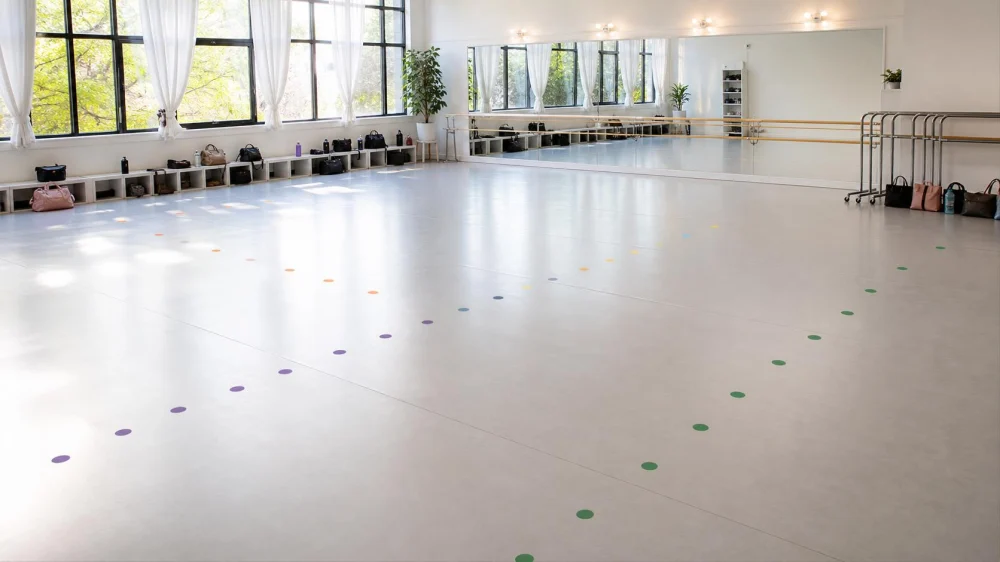
Arrive early enough to learn the room rather than discovering hazards during a turn. Notice:
- Entrances, exits, steps, pillars, radiators, and low fixtures
- Floor seams, wet spots, debris, tape, cables, and changes in surface
- Mirrors, portable barres, speakers, bags, water bottles, and camera tripods
- The designated direction for traveling combinations
- Where dancers wait and where they finish
Report a wet, damaged, or inconsistent area to the teacher instead of dancing around it silently. Do not place personal belongings at the floor edge where a dancer may travel beyond the marked area.
The International Association for Dance Medicine & Science offers public resource papers for dancers and teachers on safe dance practice, including topics such as warm-up, mirrors, motor learning, dance fitness, and proprioception. Studio habits should fit the style, floor, class level, and teacher's plan.
Virginia Ballet Company & School / virginia ballet company
5595 Guinea Rd, Fairfax, VA 22032, USA
Build reliable spacing habits
Use more than fingertip distance. A combination may include a reach, tilt, kick, turn, leap, or recovery step that extends beyond the starting footprint. Imagine a movement bubble that grows with speed and level changes.
- Begin on the teacher's assigned spot or line.
- Scan beside and behind you before a large movement.
- Stagger with neighboring dancers rather than forming hidden rows directly behind one another.
- Keep peripheral awareness instead of staring only at the teacher or mirror.
- Reduce travel, reach, or turn count when spacing becomes tight.
- Reset to your own place without cutting through another dancer's path.
Do not claim a permanent “favorite spot.” The teacher may rotate lines so everyone can see and use space equitably.
Handle traveling combinations and lines
Across-the-floor work needs a clear launch point, travel lane, finish zone, and return route. Listen for group size and timing before joining.
- Watch the first group to understand the diagonal or lane.
- Enter only when the group ahead has cleared the likely landing area.
- Maintain the assigned direction instead of drifting toward the mirror or center.
- If you forget the phrase, exit safely to the nearest clear side rather than stopping in the lane.
- After finishing, move fully out of the landing zone before celebrating, checking video, or giving feedback.
- Return around the room's perimeter using the route the teacher specifies.
Faster dancers should not overtake without permission. Slower dancers should not be pressured into a pace that removes control. The teacher can regroup lanes or adjust intervals.
Share space in partner and group work
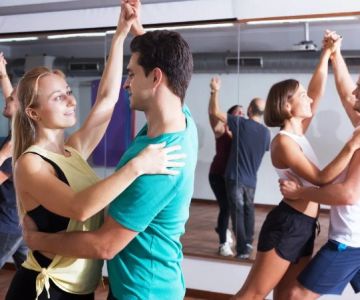
Partnering adds another person's mass, momentum, consent, and movement history. Confirm the task, roles, contact points, direction, and stop signal before beginning.
- Ask before touching or changing a contact point.
- Mark the pattern slowly without lifts or full weight transfer.
- Check neighboring groups through the complete phrase.
- Use the teacher's progression for supports, counterbalance, and lifts.
- Stop if grip, footing, timing, consent, or communication is lost.
- Do not improvise a catch or lift to avoid another group; stop the phrase instead.
Body size, experience, and assigned role do not determine consent. A dancer may ask to modify or pause contact without ridicule.
Use mirrors without losing awareness
A mirror can help with alignment and group spacing, but the reflected image reverses direction and can narrow attention. Practice shifting focus among the teacher, your reflection, neighboring dancers, and the real room.
When turning away from the mirror, orient to fixed landmarks such as a wall corner or door. Do not step backward solely by watching the reflection. In a crowded class, reduce large backward travel unless the teacher has established a clear lane.
Portable mirrors must be secured and positioned by authorized staff. Do not lean on mirrors, barres, or wall panels.
Respond to near misses and collisions
After a near miss, stop if needed, acknowledge it, and determine why the paths crossed. Possible fixes include a longer interval, smaller movement, different line, clearer finish zone, or revised traffic direction.
After contact:
- Stop both dancers and nearby movement.
- Check for injury without immediately pulling someone up.
- Notify the teacher and follow the studio's first-aid plan.
- Clear the area and identify any floor or equipment hazard.
- Do not resume until both dancers and the teacher agree it is appropriate.
- Document the incident if the studio procedure requires it.
An apology is helpful, but blame during class does not solve the traffic pattern. Focus first on care and prevention.
Include different bodies and mobility needs
Not every dancer uses space in the same way. Wheelchairs, canes, prostheses, balance needs, hearing or vision differences, pregnancy, and injury modifications can change the movement path or communication method.
The teacher can establish:
- Wider lanes or longer intervals
- A predictable route with clear landmarks
- Visual and verbal start cues
- Alternative levels, directions, or travel distances
- A no-contact or reduced-contact option
- Accessible entry, exit, and rest areas
Ask the dancer what support is useful rather than moving a mobility device, touching, or assigning a modification without consent.
Safety and medical boundaries
This article provides general studio etiquette and safety education, not choreography, medical care, or a substitute for the teacher's directions. Floor traction, footwear, movement vocabulary, class size, and acceptable spacing vary by dance style.
Stop for sharp pain, a head impact, joint instability, faintness, severe dizziness, chest symptoms, or difficulty bearing weight. Seek urgent medical help for emergency symptoms. After a fall or collision, do not continue merely to avoid interrupting class.
A psychologically safe studio allows dancers to report hazards, ask for spacing, decline inappropriate contact, and admit confusion without humiliation.
Frequently asked questions
What should I do if someone keeps drifting into my space?
Increase distance if possible and tell the teacher calmly. The class may need staggered lines, clearer spots, or smaller movement.
Can I mark a combination smaller in a crowded room?
Usually, but follow the teacher's instruction. Reducing travel or reach is safer than forcing full movement into inadequate space.
Who has priority during across-the-floor work?
Follow the teacher's group order and established lane. Do not enter because you think your speed should give priority.
Should I watch the mirror during turns?
Use spotting and focus methods appropriate to the style and teacher. Maintain awareness of the real room rather than relying only on reflection.
Is touching acceptable during partner work?
Only within the explained task and with ongoing consent. Ask before changing contact, pressure, or role.
Conclusion and floorcraft checklist
Scan the floor, leave a movement margin, follow traffic patterns, wait for clear lanes, exit finish zones, and communicate in partner work. Use mirrors as one source of information, not your only awareness. Safe floorcraft is a shared skill: each dancer manages their own path while helping the whole room move with clarity and respect.

 Messina Dance | Durham5.0 (22 reviews)
 Palmyra Academy of Dance4.0 (16 reviews)
 Brunswick School of Dance5.0 (7 reviews)
 D & K 's Studio Of Dance Piano & Fitness4.0 (18 reviews)
 Holliday Dance5.0 (1 reviews)
 Mudra Arts Center4.0 (66 reviews)
 My Story of Learning to Dance After 10 Years of Not Moving — Age Doesn’t Stop You
 Dance Classes for Seniors: Benefits and What to Look For
 My Story of Choreographing for a Space Station Party — My Story
 My Experience With Dance Intensive Week — Lessons and Takeaways
 htmlCopy codeHow I Learned to Teach Social Dance at Weddings — My Story
 How I Learned to Use Improvisation in My Dance Style — My Story