
Dance Partner Consent: Ask Before Touching or Lifting
On this page
Quick answer
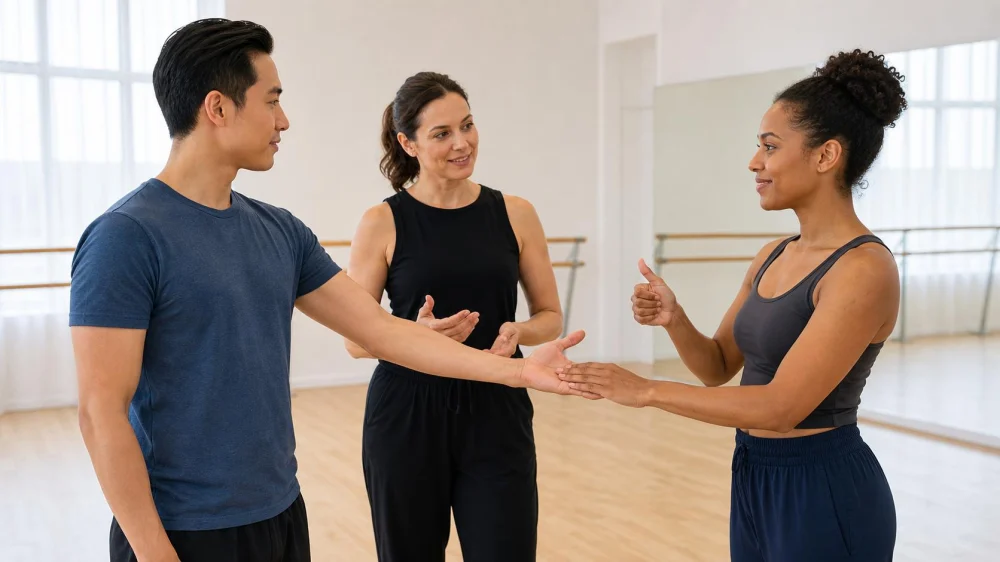
Before partner dance contact, name the exercise, where contact will occur, each person's role, speed, weight-sharing level, and stop signal. Ask for a clear yes; silence, freezing, previous participation, or an instructor assigning partners is not the same as current agreement. Either dancer can pause, change the contact, request another partner, or opt for a no-contact version without being pressured.
This guide is for U.S. dance classes, rehearsals, and workshops. Studio policy, safeguarding requirements, age, choreography, genre, professional contracts, and local law can add obligations.

Steps of Faith Dance Studio / steps of faith celina
695 N Preston Rd Ste 180, Celina, TX 75009, USA
What consent means in dance class
Consent is a voluntary, informed, specific, and reversible agreement to the contact or task happening now. It is a continuing conversation, not a one-time form or assumption.
- Voluntary: the dancer can say no without punishment, ridicule, or retaliation.
- Informed: both people understand the contact, direction, speed, load, and goal.
- Specific: agreement to hold hands does not automatically include the waist, torso, head, or a lift.
- Reversible: a yes can become a pause or no at any time.
- Current: consent in yesterday's rehearsal does not replace today's check-in.
A dancer does not need to disclose a diagnosis, trauma, religion, pregnancy, injury history, or personal reason to request a boundary or alternative.

Blooming Lotus Dance Studio LLC / dance studios harrisburg pa
HarrisburgDauphin CountyPennsylvania
5610 Derry St Suite 08, Harrisburg, PA 17111, USA
Agree on the task before moving
- Listen to the full teacher demonstration before choosing contact.
- Name roles: leader and follower, base and flyer, supporter and mover, or another class-specific term.
- Identify contact points using neutral language: hand, forearm, shoulder blade, side waist, or another exact location.
- Agree on pressure, speed, range, and whether body weight is shared.
- Ask about injuries, access needs, or boundaries without demanding private details.
- Confirm the verbal and nonverbal stop signals.
- Begin with the lowest-complexity version and build only after both partners agree.
Useful language is short: “May I place my right hand on your shoulder blade for this exercise?” “Are you comfortable sharing weight?” “I prefer no waist contact; can we use forearms?”
Use clear stop and reset signals
Choose a verbal cue that is easy to hear, such as “stop” or “down,” plus a nonverbal cue for noisy rooms. The signal must immediately reduce load and end the movement through the safest available pathway.
- Stop for pain, fear, loss of grip, missed timing, unstable footing, confusion, or a boundary change.
- Do not ask “Are you sure?” repeatedly after a no.
- Reset both dancers' footing and orientation before discussing the next attempt.
- Ask the teacher when partners disagree about mechanics or a safe exit.
- Do not surprise a partner with extra momentum, contact, improvisation, or a lift.
A stop is successful when both dancers respond promptly and neutrally. It is not evidence that someone failed the exercise.
Special checks before lifts
Lifts require qualified instruction, progressive preparation, appropriate flooring and space, clear roles, and an agreed exit. Enthusiasm and consent alone do not make a lift technically safe.
- Confirm the teacher has assigned and supervised the lift.
- Check the floor, ceiling, walls, mirrors, nearby dancers, costumes, hair, and jewelry.
- Practise the approach, contact, count, and exit without height.
- Identify who calls the start and who calls the immediate descent.
- Use spotters when the instructor requires them and clarify their contact.
- Stop if fatigue, pain, fear, missed timing, or a changed condition affects either dancer.
Do not practise a social-media lift, performance trick, or teacher's advanced demonstration unsupervised. Partners should be matched by task readiness and technique, not pressure about body size or gender.
What teachers and studios can do
- Explain contact points and risks before assigning partners.
- Provide no-contact, self-touch, prop, marking, or observer alternatives.
- Normalize partner changes and boundary updates.
- Use age-appropriate safeguarding and guardian communication.
- Set a clear process for reporting injury, harassment, retaliation, or policy concerns.
- Avoid using students to demonstrate unannounced touch.
- Check consent again when choreography, costume, casting, or contact changes.
Instructors hold authority, so an invitation to opt out must be credible in practice. Students should not lose attention, roles, or advancement merely for requesting an appropriate alternative, subject to legitimate requirements communicated in advance.
Limits and reporting concerns
This checklist does not teach lifting mechanics or decide whether a particular contact is safe. Dance medicine, physical therapy, intimacy direction, safeguarding, legal, union, and production professionals may be needed depending on the setting.
If someone ignores a stop, repeats unwanted contact, retaliates, coerces, harasses, or creates an immediate danger, leave the exercise when safe and use the studio's reporting process. For minors, follow safeguarding and mandatory-reporting requirements. Contact emergency services or appropriate authorities for immediate danger.
Write factual notes with date, location, people present, requested boundary, response, and any witnesses or communication. Protect privacy and avoid posting allegations publicly while seeking qualified help.
Frequently asked questions
Do I have to explain why I do not want contact?
No personal explanation should be required to state a boundary. You may describe the practical alternative you can use.
Can an instructor assign partners without asking?
An instructor can organize class, but assignment does not replace consent to specific touch, weight sharing, or lifts. Ask about studio policy and available alternatives.
What if my partner says yes but looks uncomfortable?
Pause and check verbally without pressure. Offer a lower-contact version or partner change. Do not treat silence or stillness as confirmation.
Should consent be written?
Policies and productions may use written forms, but a form does not replace ongoing consent in the moment. Changes still require a new check-in.
Can I change my mind during a performance process?
You can raise a new boundary. The production may need to adjust choreography, casting, staging, or professional agreements; seek union, legal, or safeguarding guidance when consequences are disputed.
Sources and evidence notes
This article applies widely used consent principles—voluntary, informed, specific, current, and reversible—to dance partnering. It does not claim one universal U.S. dance policy. Studios should publish their own contact, safeguarding, injury, reporting, and anti-retaliation procedures and align them with applicable law and professional requirements.
Next steps
Before the next partner exercise, agree on roles, exact contact points, pressure, speed, and a stop cue. Start with a low-complexity version and pause whenever conditions change. Ask your studio where consent boundaries, partner alternatives, and concerns should be recorded or reported.


 Taylor Academy of Fine Arts5.0 (2 reviews)
 Fred Astaire Dance Studios - River Oaks4.0 (55 reviews)
 Rosewood Arts Center4.0 (71 reviews)
 Texas Elks Lodge4.0 (60 reviews)
 Boehm Ballet Academy of Dance3.0 (2 reviews)
 St. Matthew's Conservatory of Classical Dance5.0 (4 reviews)
 My Story of First Time Performing in a Large Theater — The Big Night
 The Best Apps for Finding Local Dance Events and Socials
 How I Built My Home Dance Space — Setup, Mistakes & Tips
 My Story of Dancing at a Wedding (Guest & Performer) — Lessons Learned
 My Journey of Learning House Dance After Years of Studio Work — What Shifted
 The Connection Between Dance and Cultural Appreciation – Exploring Dance's Role in Understanding Global Cultures