How to Mark Dance Choreography Without Losing Detail
On this page
- Quick answer
- What marking means
- Choose the purpose of each pass
- Keep the nonnegotiable details
- Reduce size, not clarity
- Preserve timing and musical structure
- Map spacing and pathways
- Isolate difficult transitions
- Know when to return to full-out dancing
- Use marking safely
- Respect choreography and recording rules
- Marking checklist
- Frequently asked questions
- Evidence and sources
- Next steps
Quick answer
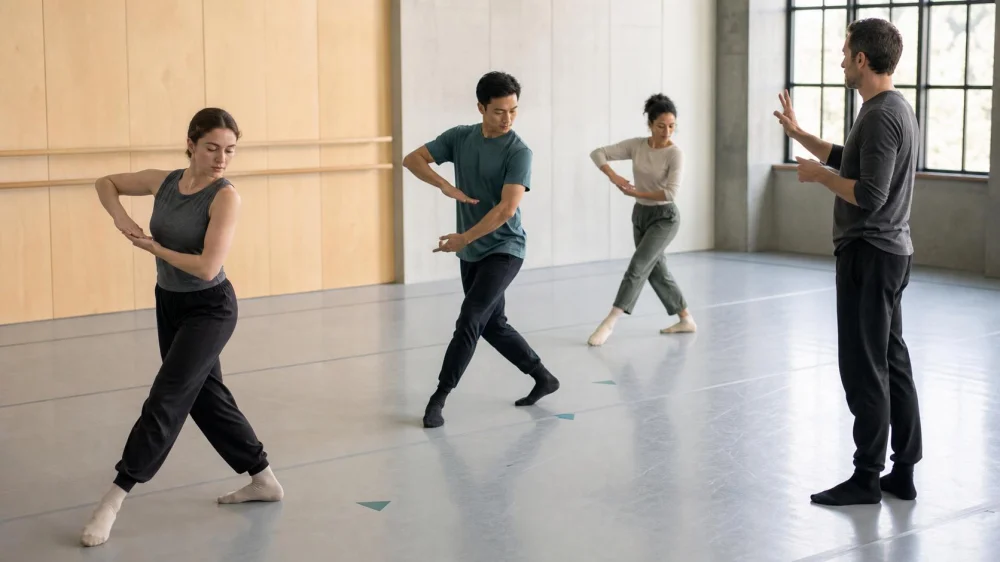
Marking dance choreography means rehearsing with intentionally reduced range, force, travel, or impact while preserving the information needed for the next full version. Keep counts, directions, focus, weight transfers, entrances, exits, partner cues, and the sequence of transitions clear.
Ask the teacher or choreographer what “mark it” means in that rehearsal. It may mean hands only, walking pathways, reduced jumps, half-size movement, or mental rehearsal with small gestures. Marking is not an excuse to skip the warm-up, ignore alignment, drift into another dancer’s space, or continue through pain.
Galactic Dance Studio / quinceanera choreography near me
8501 Long Point Rd, Houston, TX 77055, USA
What marking means
Marking is a rehearsal tool, not one fixed technique. A dancer reduces physical demand so attention can move to memory, timing, spacing, coordination, or correction. The reduction depends on genre and purpose.
A ballet dancer might keep port de bras and walk a traveling pattern. A contemporary dancer might retain weight direction while reducing floor impact. A musical-theater performer might speak rhythm and gesture entrances. A social or partner dancer might walk foot placement without speed or lifts.
Clarify the task before starting. If the teacher needs to assess performance stamina, a marked run will not provide that information. If the goal is spacing, a full-height jump may be unnecessary but the landing location still matters.
Steps of Faith Dance Studio / steps of faith celina
695 N Preston Rd Ste 180, Celina, TX 75009, USA
Choose the purpose of each pass
Give every marked repetition one question:
- What comes next?
- Which count changes direction?
- Where is the formation relative to the room?
- Which foot carries weight before the turn?
- What cue starts the entrance?
- Where does the partner connection begin?
- Which correction am I applying?
Say the purpose quietly to yourself or write it in a rehearsal note. One focused pass produces clearer information than a vague low-energy run.
When the choreographer stops the group, freeze safely and listen. Do not keep marking under the explanation unless invited; moving attention can cause you to miss the correction.
For example, a spacing pass might keep the real entrances, crossings, and final formation while replacing turns with simple step-and-face markers. A rhythm pass might stay almost in place while the feet, arms, accents, and head focus keep the musical timing. A correction pass might isolate only the eight counts affected by a new note. Naming the pass lets the group reduce the same elements together.
Keep the nonnegotiable details
Some elements should remain precise even at low intensity. Maintain the correct starting orientation, lead side, order of movements, weight-bearing foot, rhythm, eye focus when it cues another dancer, and any safety-critical hand or partner placement.
Clearly signal any deliberately omitted element. If a lift, drop, jump, turn, or floor phrase is not being executed, use the agreed placeholder rather than improvising a different action. Partners need to know whether contact and weight sharing are active.
Keep facial performance only when requested. Sometimes expression supports memory; sometimes the director wants attention on spacing. Do not let exaggerated performance hide an uncertain pathway.
Reduce size, not clarity
Shrink the movement consistently. If a traveling phrase becomes one-third size, preserve its direction and relative distances. If a leg gesture stays low, retain the correct pathway and supporting side within a comfortable range.
Avoid floppy substitutes that reverse mechanics. A tiny uncontrolled twist may be less useful than a deliberate step-and-face marker for a turn. For jumps, a clear rise, arm timing, and landing location can represent the phrase when the teacher approves.
Do not force end-range positions because the movement feels “small.” Reduced amplitude should reduce demand. Maintain control and breathe normally.
Preserve timing and musical structure
Mark with the actual counts or agreed rehearsal tempo. Identify accents, holds, syncopation, breath cues, and musical landmarks. If music is absent, count consistently or use neutral syllables.
Distinguish a hold from uncertainty. Commit to stillness on the intended count, then continue. If you lose the phrase, step safely out of the lane and rejoin at a known cue rather than rushing across others.
For tempo changes, mark the transition rather than averaging everything into one speed. The physical range can be smaller while the rhythmic relationship remains accurate.
Map spacing and pathways
Spacing rehearsals require real destinations. Use studio landmarks approved by the teacher: center, corner, wing, taped number, mirror seam, or another fixed point. Do not use a moving dancer as the only landmark.
Walk the full pathway when the goal is traffic. Keep awareness of formations, crossings, entrances, exits, and sightlines. A marked phrase that stays in place cannot test whether two routes collide.
When the room is smaller than the performance space, follow the scaling plan. Do not individually decide to travel full distance while everyone else compresses.
Isolate difficult transitions
Memory often fails between recognizable movements. Identify the last clear position before the gap and the first clear position after it. Mark the transfer between those points slowly, then place it back into the count.
Write a short cue based on action: “land left, look upstage, step behind.” Avoid a long paragraph. Confirm vocabulary and direction with the teacher rather than copying another dancer’s uncertain notes.
Repeat only as many times as assigned. Extra repetitions at the side can block space, add load, or conflict with the rehearsal plan.
Know when to return to full-out dancing
Marking cannot test every demand. Full choreography may require cardiovascular preparation, power, landing control, costume management, partner load, and performance focus. IADMS dance-fitness resources note that class and rehearsal demands can differ from performance demands, so reduced work should not be treated as complete performance preparation.
Use the teacher’s progression: walk-through, marked pass, medium pass, selected full sections, then a full run when appropriate. Build travel and impact gradually. Check that the floor, footwear, costume, and partner are ready.
After a marked pass, state what still needs a full test, such as lift timing, turn speed, stamina, or an entrance from offstage.
Before the first full version, restore one demand at a time when the rehearsal plan allows. Increase travel while keeping impact reduced, then add turning speed, then test selected jumps or partner load. This is not a universal progression; the teacher chooses the sequence. Its value is that dancers can identify which added demand changes timing, spacing, or control instead of changing everything at once.
Use marking safely
Warm up for the session even if the first run is marked. Reduced intensity does not eliminate sudden direction changes, balance demands, floor transitions, or partner contact.
Do not use marking to self-prescribe a return from injury. A healthcare professional and teacher may need to set limits on jumping, range, repetition, weight bearing, or contact. Stop for sudden severe pain, dizziness, suspected concussion, inability to bear weight, or a joint giving way.
Fatigue can reduce coordination. If marking is requested to manage rehearsal load, keep the movement honest and controlled rather than adding bursts of unplanned full power.
Respect choreography and recording rules
Marking can be documented with notes, counts, or video only when the choreographer and studio permit it. Obtain consent from everyone visible and never record in changing areas.
Do not post unpublished choreography, rehearsal mistakes, cast formations, music edits, or a teacher’s private correction. Label personal notes with the current version date because choreography can change.
If a rehearsal assistant provides an approved reference video, save the official version and its date. Avoid building a private library of conflicting clips from different angles and rehearsal stages. Delete or archive superseded files as the production directs, and do not forward access links beyond the authorized group.
Marking checklist
- Ask what “mark” means for this pass.
- Name one purpose: memory, timing, spacing, or correction.
- Keep sequence, weight shift, direction, and counts.
- Use agreed placeholders for risky or omitted skills.
- Walk real pathways when spacing is the goal.
- Preserve partner cues without unapproved load.
- Identify what still needs a full-out test.
- Stop for pain or a safety concern.
Frequently asked questions
Is marking the same as dancing lazily?
No. Good marking lowers selected physical demands while keeping chosen information precise. It requires attention and clear intention.
Should I mark jumps by doing small jumps?
Only if the teacher approves. A rise, arm pathway, and landing marker may be more appropriate depending on the goal and your condition.
Can I mark partner work alone?
You can review your own pathway, but do not simulate lifts, catches, or weight sharing without the assigned partner and supervision.
Does marking count as a warm-up?
Not necessarily. Follow the class warm-up and teacher’s progression before higher-range or high-impact movement.
Evidence and sources
Next steps
In your next rehearsal, ask for the purpose of the first marked pass. Choose one question, preserve the essential counts and pathways, then note what still requires full execution.
Afterward, write one action cue for the hardest transition and confirm it with the teacher before repeating it on your own.

 Mishnock Barn4.0 (157 reviews)
 ISD 728 Community Education4.0 (7 reviews)
 Downstage Center4.0 (76 reviews)
 Dance Vision Studios - Pearland5.0 (18 reviews)
 The Pantherette Palace Dance Academy5.0 (1 reviews)
 Orinoco Fitness4.0 (8 reviews)
 The Best Mindset for Learning and Retaining Dance Choreography
 The Connection Between Dance and Cultural Appreciation – Exploring Dance's Role in Understanding Global Cultures
 How Music Theory Influences Dance: A Deep Dive
 How I Learned to Use Motion-Capture Gloves in My Dance Rehearsal — My Story
 My Experience With My First Live‑Stream Dance Battle — My Story
 How Dance Helped Me Lose Weight and Find a Community