
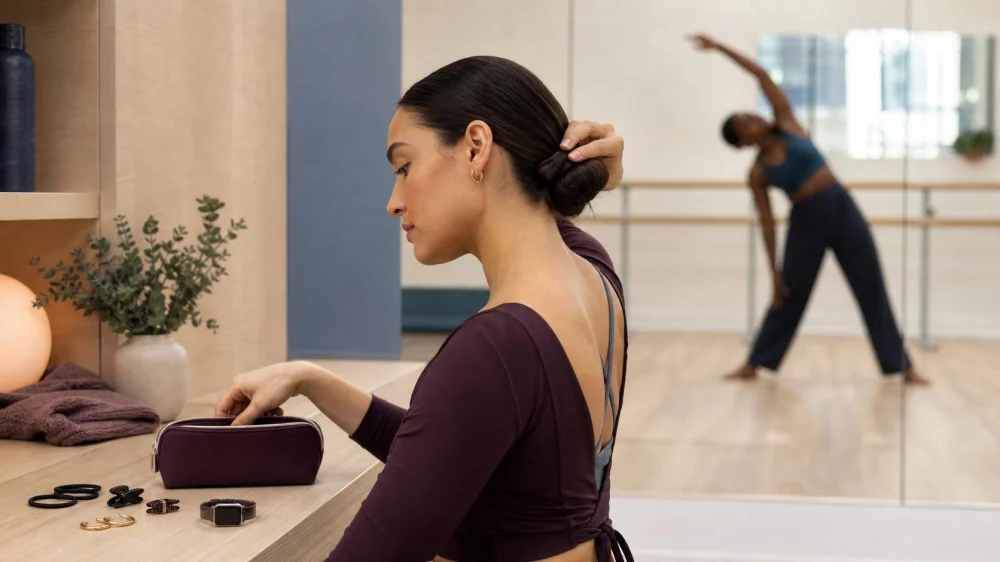
Dance Class Hair and Accessories: Secure Them for Movement
Table of contents
Quick answer
Follow the dress code for the class, then secure hair so your face, neck, vision, and partner space stay clear through turns, jumps, floorwork, and inversions. Use soft, dependable ties and only the pins or coverings the studio permits. Remove dangling or hard jewelry and store it before entering. Test with gentle head turns and a forward fold, then adjust outside the dance area.

Rock City Dance Center - Conway / rock city dance center conway
1058 Front St #102, Conway, AR 72032, USA
Check the style and studio rules
A classical ballet class may require a bun that reveals the neck and head line, while contemporary, hip-hop, tap, or social dance may allow a braid, ponytail, wrap, or another secure style. Performances can add costume headpieces and precise placement that ordinary classes do not require.
Read the current dress code and ask the instructor what “hair secured” means for that class. Confirm rules for earrings, watches, rings, facial piercings, head coverings, decorative clips, and wearable devices. Do this before buying accessories or copying another dancer's setup.
Class Act Performing Arts / class act studios
EdgewaterAnne Arundel CountyMaryland
161 Mitchells Chance Rd, Edgewater, MD 21037, USA
Plan for the movement, not just the mirror
A style can look secure while standing still but loosen during spotting, fast direction changes, rolling, partnering, or repeated jumps. Consider where hair travels and what might happen if it releases. A long high ponytail can strike the dancer or a partner; a rigid clip at the back of the head can press into the floor.
Review the class format. For floorwork, avoid a bulky knot exactly where the head will contact the floor. For partnering, contain long lengths that could catch on a hand or costume. For turns, keep hair out of the eyes without tightening it so much that it causes discomfort.
Secure different hair lengths and textures
The goal is stable movement, not forcing every dancer into one hairstyle. Options can include:
- soft elastics for a ponytail, braid, bun, puff, or gathered short sections;
- braids or twists secured so their length does not whip into the face or partner space;
- locs gathered with a wide, soft tie that does not strain individual roots;
- short hair held back with a permitted soft band; or
- a religious or cultural head covering secured according to studio guidance and the dancer's needs.
Use a method that works with the hair rather than repeatedly pulling it tighter. If a required style risks hair or scalp damage, discuss a visually neat alternative with the instructor. Bring backup ties that match the approved setup.
Remove or replace hard accessories
Dangling earrings, hoops, necklaces, bracelets, rings, watches, and rigid hair ornaments can catch clothing, strike another dancer, or press into the body. Several university dance programs explicitly direct students to remove obtrusive jewelry and secure hair away from the face.
Place removed items in a small closed pouch inside a locker or dance bag. Do not leave them on the floor, barre, sound table, or windowsill. Replace decorative claws or heavy barrettes with soft ties and the minimum permitted pins. Ask before covering a piercing with tape; studio policies differ, and tape does not eliminate the hard item underneath.
Use a short movement test
- Turn the head comfortably in both directions.
- Look down, fold forward gently, and return upright.
- Raise both arms and check that sleeves or hands do not snag the hair.
- Perform one easy spot, bounce, or style-specific action.
- Check that the style stays clear of the eyes and does not pull painfully.
Run this test in the changing area, not in a crowded traffic path. If pins move, a tie slides, or an accessory hits the head, rebuild the style before the full warm-up.
Handle mid-class repairs off the floor
If hair comes loose, signal the instructor and move to the approved edge or changing area. Pick up every dropped elastic or pin immediately; a small object on the dance floor can become a hazard. Do not restyle in the middle of a combination or shed loose hair and products onto the floor.
Avoid spraying aerosol, adding oil, or applying slippery product inside the studio. Some programs restrict scented products or hairstyling on the dance floor because residue and loose hair can affect shared space. Return only after the style passes the movement check again.
Pre-class hair and accessory checklist
- The hairstyle matches today's class and dress code.
- Hair stays clear of the face, eyes, and partner space.
- The setup works for turns, jumps, floorwork, and inversions as applicable.
- Soft ties are secure without painful tension.
- Hard clips, dangling jewelry, watches, and loose accessories are removed.
- Approved pins or coverings cannot fall easily.
- Removed items are stored in a closed pouch off the floor.
- Backup ties are available for a quick repair.
Limits and individual needs
This article provides general studio preparation guidance. Hair, scalp needs, sensory needs, religious practices, medical devices, dance styles, and performance requirements differ. The studio's current policy and respectful discussion with the instructor should guide individual adjustments.
Stop and loosen the style if it causes scalp pain, headache, skin irritation, numbness, or visible pulling. Do not use a pin, adhesive, or product that damages hair or skin merely to satisfy an assumed appearance rule. Seek appropriate professional advice for persistent scalp or skin problems.
Frequently asked questions
Does every dance class require a bun?
No. Requirements vary by style, level, school, and performance. A secure braid, ponytail, short style, or covering may be accepted. Check the actual dress code.
Can I wear small stud earrings?
Only if the studio permits them for that activity. Even small hard items can press, snag, or become a concern during partnering and floorwork.
What if a bun hurts during floorwork?
Tell the instructor and ask whether its placement can change. A lower, flatter, or differently secured style may protect movement lines without putting a hard knot under the head.
Should I use hairspray before class?
Follow the studio policy. Some spaces are scent-free or discourage styling products that can transfer residue. Soft ties and a stable method may be enough for ordinary class.
Rules and sources
- UNC Asheville Dance: Class Preparation, Safety, and Etiquette
- University of Washington Department of Dance: Dance Studio Guidelines
- Boston University: Dance Program Policies
- University of Utah School of Dance: Ballet Dress Code
Conclusion and next steps
Build the setup around the movement: learn the class rule, choose a secure low-risk style, remove hard accessories, and test before warm-up. The best arrangement stays comfortably out of mind so attention can move to musicality, space, and the dancers around you.

 Lyra Noire0.0 (0 reviews)
 Srutilaya School of Dance4.0 (4 reviews)
 South Carolina Summer Dance Conservatory0.0 (0 reviews)
 Fusion Dance4.0 (19 reviews)
 Glenview Park District - Park Center4.0 (102 reviews)
 Dynamic Dance Studio3.0 (3 reviews)
 My Story of Starting a Student-Run Dance Club at College — What I Did
 How to Give Back to the Dance Community as a Student
 How to Find Free Dance Classes at Community Centers: A Step-by-Step Guide
 How I Learned to Use Virtual Space to Perform Live Dance – My Story
 How I Balance Technique vs Creativity in My Choreography Process
 How I Learned to Use AI Choreographers in My Studio — My Story