
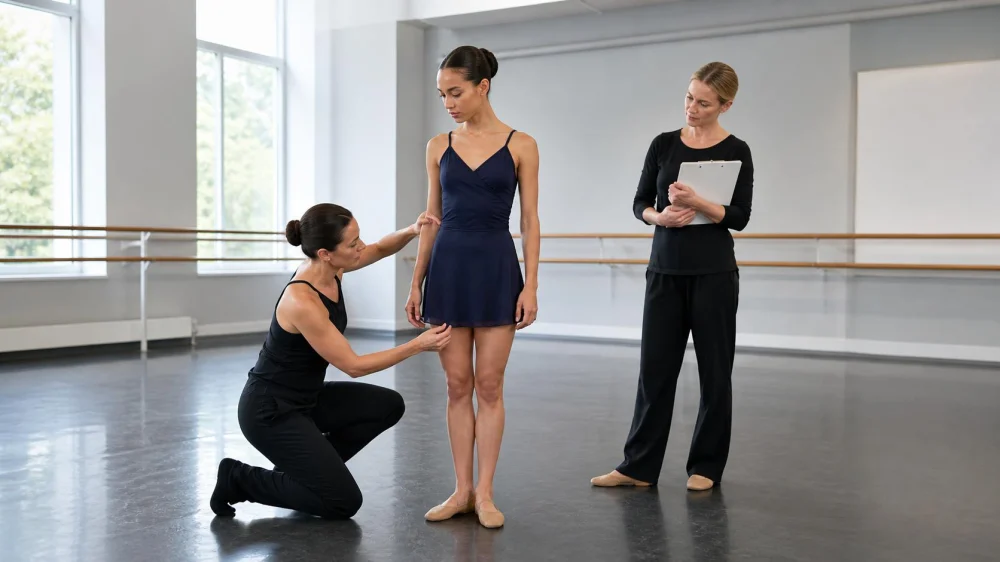
Dance Costume Check: Fasteners, Hems, Shoes, and Motion
On this page
Quick answer
Test a dance costume in the correct shoes and under rehearsal conditions before performing at full speed. Check closures, hems, straps, ornaments, pockets, visibility, floor contact, skin friction, and any quick-change path. Move through a slow version of the choreography, then repair or simplify anything that shifts, catches, restricts breathing, blocks sight, or could drop onto the floor.

Rock City Dance Center - Conway / rock city dance center
1058 Front St #102, Conway, AR 72032, USA
Why a costume needs a movement test
A garment that fits while standing can pull, twist, open, trail, or obstruct vision during turns, jumps, floor work, partnering, or lifts. Fabric changes with sweat, lighting, repeated wear, and laundering. Shoes, accessories, microphones, props, and underlayers also interact with the costume, so a complete test uses the actual combination rather than inspecting each item alone.
This guide is for dancers, teachers, wardrobe teams, and families preparing costumes in United States studio or performance settings. It is not tailoring, rigging, medical, fire-code, or child-safeguarding advice. Production rules, dance style, age, choreography, venue, and costume materials determine the final requirements.
The Little Gym of Pearland / the little gym pearland
9607 Broadway St, Pearland, TX 77584, USA
Practical checklist
- Correct dancer, piece, costume version, underlayers, tights, support garments, socks, shoes, accessories, hair plan, and makeup transfer risk.
- Zippers, hooks, snaps, buttons, ties, elastic, straps, closures, modesty panels, and backup fasteners for security and skin comfort.
- Hem and train length during standing, plié, lunge, kick, turn, jump, kneel, floor work, partnering, stairs, and backstage travel.
- Shoe fit, sole condition, fastening, heel stability, traction, compatibility with the floor, and whether costume fabric can enter the shoe path.
- Vision, hearing, breathing, neck and shoulder range, hand and foot clearance, temperature, sensory comfort, and safe freedom of movement.
- Sequins, beads, feathers, pins, wire, jewellery, appliqués, fringe, detachable pieces, and anything that can scratch, catch, shed, or reflect unexpectedly.
- Quick-change time, route, privacy, helpers, labels, order of removal and dressing, storage, lighting, communication, and contingency item.
Step-by-step plan
- Confirm the complete assigned costume and shoes against the production list, then inspect every closure and attachment in bright light.
- Dress in an appropriate private area with required helpers and safeguarding practices. Avoid last-minute changes that the dancer has not tested.
- Check neutral standing fit, breathing, vision, skin pressure, and shoe security before attempting choreography.
- Run the movement vocabulary slowly: reach, bend, turn, kick, jump preparation, floor transition, partner position, and entrance or exit path as applicable.
- Mark any shift, opening, drag, catch, rub, sound, lost ornament, or visibility problem and stop before repeating at speed.
- Have the responsible wardrobe person repair, shorten, secure, remove, or replace the item using methods approved for the fabric and production.
- Re-test the altered costume, document the final setup, pack it in order, and inspect again after laundering, transport, or a performance.
Keep a private costume card with dancer and piece, each item, shoe, closure order, approved underlayers, alteration, helper, quick-change sequence, skin or sensory concern, cleaning method, inspection date, missing or loose item, and final sign-off. Avoid displaying private body measurements unnecessarily.
Limits and important notes
Do not use ordinary safety pins, glue, tape, or improvised ties as universal fixes. A method may fail under sweat and movement, damage fabric, create a sharp point, or block a fast exit. Do not require a dancer to accept pain, breathing restriction, unsafe exposure, or a safeguarding concern to preserve appearance.
Stop rehearsal for breathing restriction, faintness, sharp hardware, significant skin injury, a loose shoe, blocked vision, a costume caught in equipment, or an item on the dance floor. Notify the teacher, stage manager, wardrobe lead, and venue staff as appropriate. Follow emergency and safeguarding procedures for injury or privacy concerns.
Frequently asked questions
When should the first full costume test happen?
Allow enough time before performance for movement testing, alteration, shoe checks, cleaning, and a complete re-test.
Can a costume be checked without the performance shoes?
A preliminary fitting can, but hem, traction, balance, and clearance need the actual approved shoe and floor context.
What if a decoration keeps falling off?
Stop using or secure it through the responsible wardrobe process; loose pieces can create floor and partner hazards.
Should dancers practise the entire routine in costume?
Follow the teacher and production plan, but test every relevant movement, transition, partner contact, and entrance or exit.
How do quick changes become safer?
Rehearse the route, privacy, helpers, garment order, closures, storage, lighting, timing, stop cues, and backup plan.
Sources and evidence
Use the production's current costume plot, choreography notes, studio and venue policies, shoe and material care instructions, safeguarding plan, and direction from the teacher, wardrobe lead, and stage manager. Product and venue requirements override generic fastening or floor assumptions.
Conclusion and next steps
Assemble the complete look, inspect it while still, and then test every relevant movement slowly in the correct shoes. Repair and re-test anything that shifts, drags, catches, sheds, restricts, or blocks vision. A documented setup and rehearsed change path reduce surprises more reliably than a rushed backstage fix.


 Mae the Bellydancer0.0 (0 reviews)
 S & L Dance Studio Inc.0.0 (0 reviews)
 Hot Styles Dance Company5.0 (7 reviews)
 Step II Dance Center5.0 (14 reviews)
 Dance from the Heart4.0 (5 reviews)
 NrityaShastra Bharatanatyam Academy4.0 (30 reviews)
 Dance Partner Rotation: Use Names, Boundaries, and Clear Reset Cues
 How I Use Visualization Techniques Before Every Performance
 Telepathic Dance Collaboration Story: My Journey Into Creative Movement Communication
 What is Line Dancing and Where to Find Country Bars with Lessons
 My Experience of Teaching Dance in Schools — What I Learned About Kids
 Why I Switched from Tap to Contemporary Dance – My Personal Journey and Lessons Learned