Ready for the Next Dance Level? A Skills Checklist
On this page
Quick answer
You may be ready for the next dance level when you can keep basic timing, maintain spacing, remember common vocabulary, adapt to corrections and complete the current class with consistent technique—not merely survive it. Ask the teacher which skills define the next level, then try one approved class while continuing foundational training. Moving up should add complexity without forcing pain, panic or unsafe speed.
What a dance-class level really means
Dance-class level is a studio-specific grouping based on expected vocabulary, learning pace, coordination, technique, musicality and sometimes age or audition. “Beginner,” “intermediate” and “advanced” are not standardized across U.S. studios.
Time enrolled can support learning but does not prove readiness. A dancer may be strong in rhythm and performance while still developing alignment, turns or spatial awareness. Different styles also transfer unevenly.

Crunch Fitness - Ballantyne / crunch fitness ballantyne
CharlotteMecklenburg CountyNorth Carolina
16045 Johnston Rd A, Charlotte, NC 28277, USA
Readiness skills to look for
- Timing: you can find the beat and recover after losing it.
- Vocabulary: common steps and directions need less explanation.
- Learning pace: you retain short combinations after several demonstrations.
- Technique: foundational alignment remains stable as tempo increases.
- Spatial awareness: you travel predictably without crowding others.
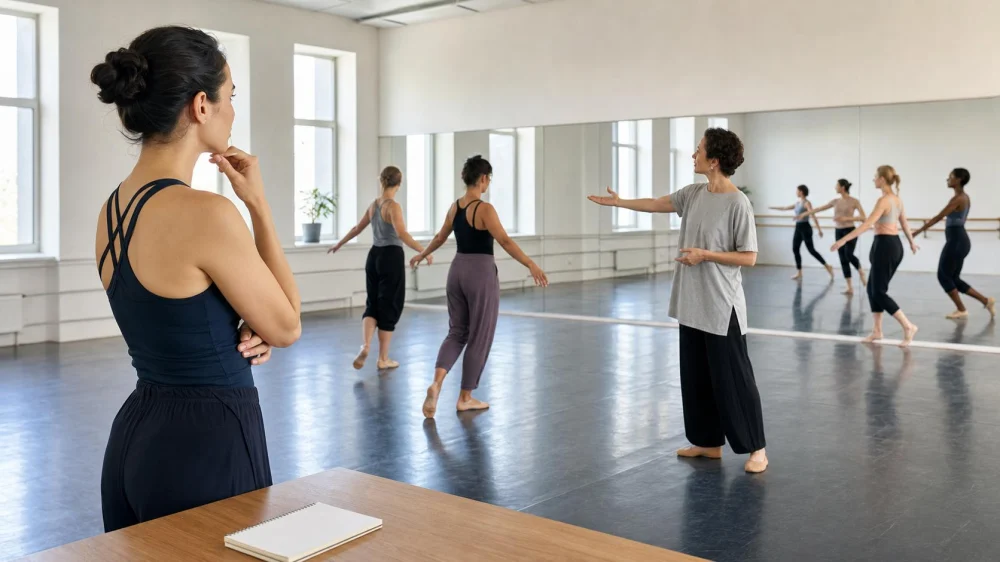
- Corrections: you can apply one or two cues while continuing to move.
- Stamina: fatigue does not consistently erase safe form.
- Independence: you can practice without copying a neighbour every count.
Best sign of readiness: current-level skills are repeatable on an ordinary day. Not enough by itself: performing one favourite combination well.
A four-class self-check
- Choose four regular classes rather than judging one unusually easy day.
- After each class, note timing, memory, technique, spacing and recovery.
- Mark which corrections repeated and whether you applied them.
- Notice if you finished focused or relied on risky momentum when tired.
- Ask whether unfamiliar combinations were manageable, not perfect.
- Compare the pattern across classes and bring it to the teacher.
A log should describe behaviours, not label talent. “Lost the final direction change twice” is more useful than “bad at choreography.”
Ask for specific teacher feedback
- Which three skills are required for the next class?
- Which current habit would be unsafe at a faster pace?
- Should I add, replace or alternate a class?
- Is there a bridge class, workshop or fundamentals section?
- Which part of the next class should I mark rather than perform fully?
- When should we reassess?
Ask at an appropriate time rather than during another student's correction. A useful answer names observable skills and a path to improve, not only praise or a vague deadline.
Try the next level without abandoning basics
- Get instructor approval and tell the next teacher it is your first visit.
- Stand where you can see without blocking established traffic.
- Mark unfamiliar jumps, turns or floor patterns before attempting full speed.
- Prioritize timing and pathways over performance details.
- Step aside safely if lost rather than crossing the room unpredictably.
- Continue a fundamentals class to reinforce technique.
- Evaluate the following day: useful challenge, excessive soreness, confusion and recovery.
When staying at the current level is useful
- Basic alignment disappears whenever tempo rises.
- You frequently collide, reverse traffic or miss stop cues.
- Current combinations require constant visual copying.
- Pain or unresolved injury limits foundational movement.
- You leave most classes too overwhelmed to identify what you learned.
- The next level includes unsupported skills you have not been taught progressively.
Repeating a level is not stagnation. It can improve musical detail, control, confidence and consistency while protecting long-term progress.
Health and scope notes
This guide provides general dance-training information. Studios use different curricula and placement rules, and only the teacher can assess the class-specific demands. It is not medical advice.
Stop for sharp pain, dizziness, fainting, chest symptoms or loss of control. Follow healthcare or rehabilitation guidance rather than using a class level as a recovery test.
Frequently asked questions
How long should I stay in beginner class?
There is no universal duration. Readiness depends on consistent skills and the studio's curriculum, not a fixed number of months.
Can I take two levels at once?
Often, with teacher approval. A foundation class plus an occasional higher-level class can support transition if total load remains manageable.
What if my friends moved up first?
Placement is individual. Use your own technique, safety and learning needs rather than matching another person's schedule.
Should I audition for placement?
Follow the studio process. An audition can clarify expectations, but one performance may not show everyday consistency.
What if the next class feels impossible?
Return to the current level, ask which gap mattered most and build a specific bridge plan. One difficult class is useful information, not failure.
Next steps
Track four current classes using timing, vocabulary, memory, technique, spacing and recovery. Ask the teacher for three next-level criteria, then schedule one approved trial while keeping a fundamentals class. Reassess by learning quality and safe consistency, not status.

 Poinciana Academy of Fine Arts4.0 (55 reviews)
 Dreamflight Theatrical Gymnastics, Inc.5.0 (19 reviews)
 Triple Threat Performing Arts LLC, Coral Springs, FL5.0 (23 reviews)
 Blue Label Band5.0 (24 reviews)
 Royale Ballet Dance Academy4.0 (57 reviews)
 Purpose Dance Academy5.0 (4 reviews)
 How I Learned to Use Motion-Sensing Floors in My Dance Studio
 How to Create a Dance Practice Schedule That You'll Actually Stick To
 How to Find a Dance Class with a Focus on Community
 How I Prepared My First Solo Performance — A Journey of Self‑Discovery
 What is Waacking? Punking and Arm Movements Explained for Dancers
 The Benefits of Cross-Training with Other Forms of Exercise for Better Performance